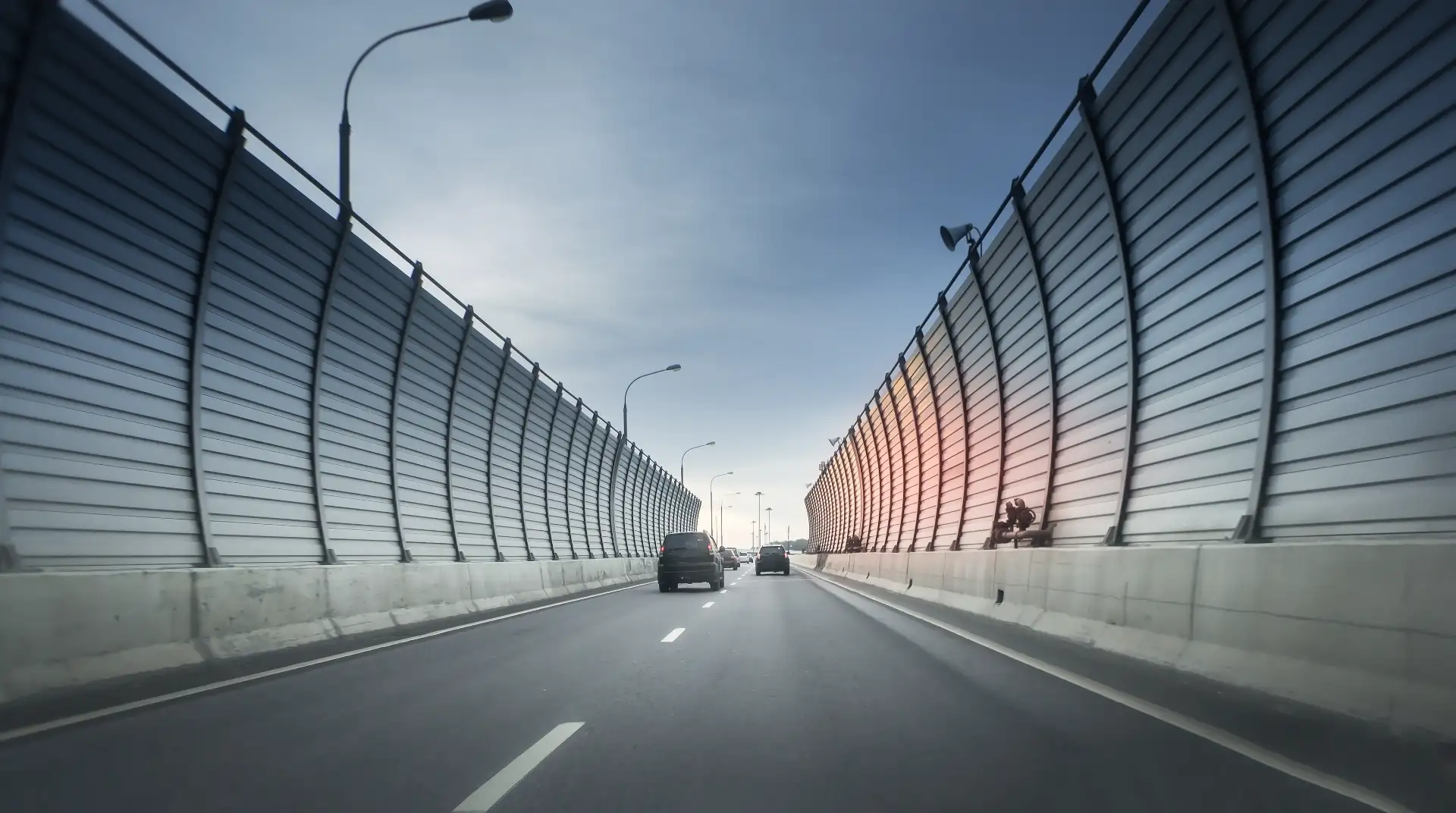
India's expressway network is expanding at an unprecedented pace. With NHAI targeting over 12,000 km of highway construction under Bharatmala Pariyojana, the demand for noise barrier systems along residential corridors has grown substantially. For EPC contractors bidding on these packages, understanding MORTH specifications, material options, and cost implications is essential to preparing a competitive and compliant tender submission.
Noise, Health & the Numbers Worldwide
- The World Health Organization ranks environmental noise among the top environmental risks to health in Europe — second only to air pollution.
- A 10 dB(A) reduction in noise level is perceived by the human ear as roughly a halving of loudness.
- Over 100 million people in Europe alone are exposed to road-traffic noise above 55 dB — the threshold WHO links to measurable health effects.
- India's CPCB limits are 75 dB(A) day / 70 dB(A) night for industrial areas, tightening to 55/45 dB(A) for residential zones.
MORTH & IRC Standards for Highway Noise Barriers
The Ministry of Road Transport and Highways (MORTH) specifies noise barrier requirements under Section 800 of the Standard Specifications for Road and Bridge Works. Additionally, IRC:SP:56 provides guidelines for the design of noise barriers along highways. Key requirements include minimum barrier height of 3 metres above road level, Sound Transmission Class (STC) rating of 25 or higher, Noise Reduction Coefficient (NRC) of 0.85 minimum for absorptive barriers, wind load resistance per IS 875 Part 3 for the specific terrain category, and corrosion protection for a minimum 25-year design life.
Material Comparison: Aluminium vs. Polycarbonate vs. Concrete
The choice of barrier material significantly impacts acoustic performance, cost, installation time, and maintenance requirements. Aluminium absorptive barriers offer NRC values of 0.85–0.95, excellent corrosion resistance, lightweight construction for easier installation, and a modular design that allows quick erection. Polycarbonate transparent barriers provide visual openness and natural light, but lower acoustic absorption (primarily reflective).
Concrete barriers offer high STC ratings and mass-based sound blocking, but require heavy foundations and longer installation timelines. For most NHAI projects, aluminium absorptive panels mounted on H-beam steel structures offer the optimal balance of acoustic performance, installation speed, and lifecycle cost.
For most NHAI projects: aluminium absorptive panels on H-beam steel posts give the best balance of acoustic absorption, fast modular erection and lifecycle cost.
Wind Load Design per IS 875
Noise barriers along elevated expressways and open terrain face significant wind loads. IS 875 Part 3 classifies terrain into four categories, with basic wind speeds ranging from 33 m/s to 55 m/s across India. The barrier structure must be designed for a 50-year return period wind speed, with appropriate drag coefficients for the panel configuration. For a typical 4-metre high barrier on an elevated expressway in Terrain Category 2 with a basic wind speed of 44 m/s, the design wind pressure at the barrier face can exceed 1.5 kN/m² — requiring robust H-beam sections and foundation design.
Cost-Performance Analysis
For EPC contractors preparing tender estimates, the following cost benchmarks provide a reference framework. Aluminium absorptive barriers range from ₹8,000–₹14,000 per square metre (supply only) depending on panel thickness and acoustic infill specification. Polycarbonate transparent barriers range from ₹6,000–₹10,000 per square metre. Concrete barriers range from ₹4,000–₹8,000 per square metre but require significantly higher foundation costs.
When lifecycle cost including maintenance, replacement, and foundation expenses is considered, aluminium absorptive systems typically offer the lowest 25-year total cost of ownership.
Installation Methodology
A well-planned installation sequence is critical for highway noise barrier projects, where work must often be coordinated with ongoing traffic management. The typical sequence involves foundation preparation (pile or pad foundations depending on soil conditions), H-beam erection using crane or boom truck, modular panel installation from ground level upward, gasket and sealant application at all panel-to-beam junctions, and final acoustic and structural inspection.
The entire process for a 1 km barrier section with 4-metre height can typically be completed in 15–20 working days with experienced erection crews.
KBG Group's Highway Noise Barrier Solutions
KBG Group manufactures aluminium absorptive noise barrier panels in our ISO 9001:2015 certified facility in Nashik, Maharashtra. We provide a complete turnkey solution — from acoustic panel manufacturing and H-beam structural fabrication to transportation, on-site erection, and commissioning with our own installation teams. Our highway barrier systems are designed to meet MORTH Section 800 and IRC:SP:56 specifications, with third-party tested acoustic performance data.
For a project-specific quotation including supply and installation, contact our technical team with your highway name, chainage details, barrier height, and total running metres.