What certification do fire and smoke dampers need in India?
Fire dampers should carry a UL 555 fire rating (commonly 1.5 or 3 hours) and smoke/combination dampers a UL 555S rating with a stated leakage class. Fire dampers close on a fusible link at ~74 °C; smoke and motorised dampers close on an actuator triggered by the fire-alarm/smoke-detection system. Match the rating to the fire-compartment and duct pressure class.
Why Fire & Smoke Dampers Matter
Ductwork is a hidden highway for fire and smoke. Where an air duct crosses a fire-rated wall or floor, it punches a hole in the building's compartmentation — unless a damper is there to close it. Fire and smoke dampers are the components that keep a building's passive fire strategy intact, and under NBC 2016 Part 4 they are not optional in most commercial and institutional buildings.
Fire, Smoke and Combination Dampers
Three related products do different jobs — specifying the wrong one is a common and costly error:
Fire damper
Closes on heat (fusible link or thermal release) to stop flame spreading through the duct across a fire barrier.
Smoke damper
Closes on a smoke-detection signal to stop smoke migrating through ducts to other zones.
Combination FSD
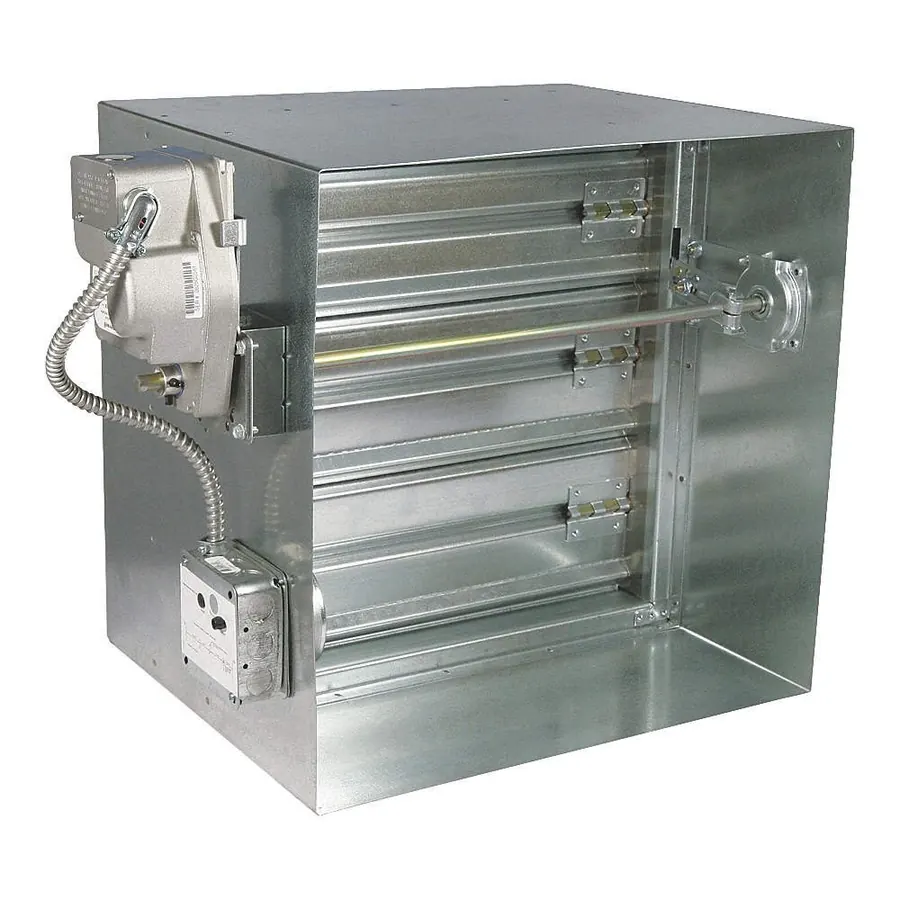
Does both — a motorised damper that responds to heat and smoke, used at critical barriers and in smoke-control systems.
Fire Ratings and Standards
Dampers are rated by how long they maintain integrity in a fire, and tested to recognised standards. Specify the rating to match the barrier they protect.
Blade Types and Actuators
Two mechanical choices affect airflow and reliability. Curtain-blade (folding) fire dampers stack out of the airstream when open, offering high free area at low cost. Multi-blade (airfoil) dampers give lower pressure drop and are used where airflow performance matters or where motorised control is needed.
Actuation ranges from a simple fusible link (melts at ~72°C to release the blade) to spring-return motorised actuators (24 V / 230 V) that also integrate with the fire-alarm and BMS for smoke control and remote testing.
Writing a Damper Specification
A tight damper clause should state: the fire-integrity rating (e.g. 120 minutes), the test standard (UL 555 / EN 1366-2), blade type, casing gauge and galvanising, actuator type and voltage, and the interface (fusible link, alarm signal, or BMS). Add access-door and test-switch requirements so the dampers can be inspected and drop-tested after installation.
Match the damper to the barrier: a 120-minute wall needs a 120-minute damper. Under-rating the damper silently defeats the fire compartment it sits in.
KBG Group Fire & Smoke Dampers
KBG Group manufactures fire, smoke and combination dampers with the blade types, ratings and actuators Indian projects specify, backed by ISO 9001:2015 quality. Send your duct schedule and fire-rating requirements and we'll match compliant dampers and quote them.
Frequently Asked Questions
What is the difference between a fire damper and a smoke damper?
A fire damper closes on heat (via a fusible link or thermal release) to stop flame spreading through ductwork across a fire barrier. A smoke damper closes on a smoke-detection signal to stop smoke migrating between zones. A combination fire/smoke damper does both.
What standards apply to fire and smoke dampers in India?
Dampers are tested to UL 555 (fire) and UL 555S (smoke), or BS EN 1366-2 (fire) and EN 1366-10 (smoke). NBC 2016 Part 4 (Fire & Life Safety) governs where dampers are required in Indian buildings.
What fire rating do I need for a damper?
Match the damper rating to the barrier it protects — a 120-minute fire wall requires a 120-minute damper. Common ratings are 90, 120 and 180 minutes.
What is a fusible link in a fire damper?
A fusible link is a heat-sensitive element (typically rated ~72°C) that melts in a fire, releasing the damper blade to close automatically. Motorised dampers can also close via spring-return actuators triggered by the fire-alarm system.
Where are fire and smoke dampers required?
Wherever HVAC ductwork penetrates a fire-rated wall, floor or shaft, and in smoke-control and pressurisation systems, as required by NBC 2016 Part 4 and the project fire strategy.