How tall should a highway noise barrier be?
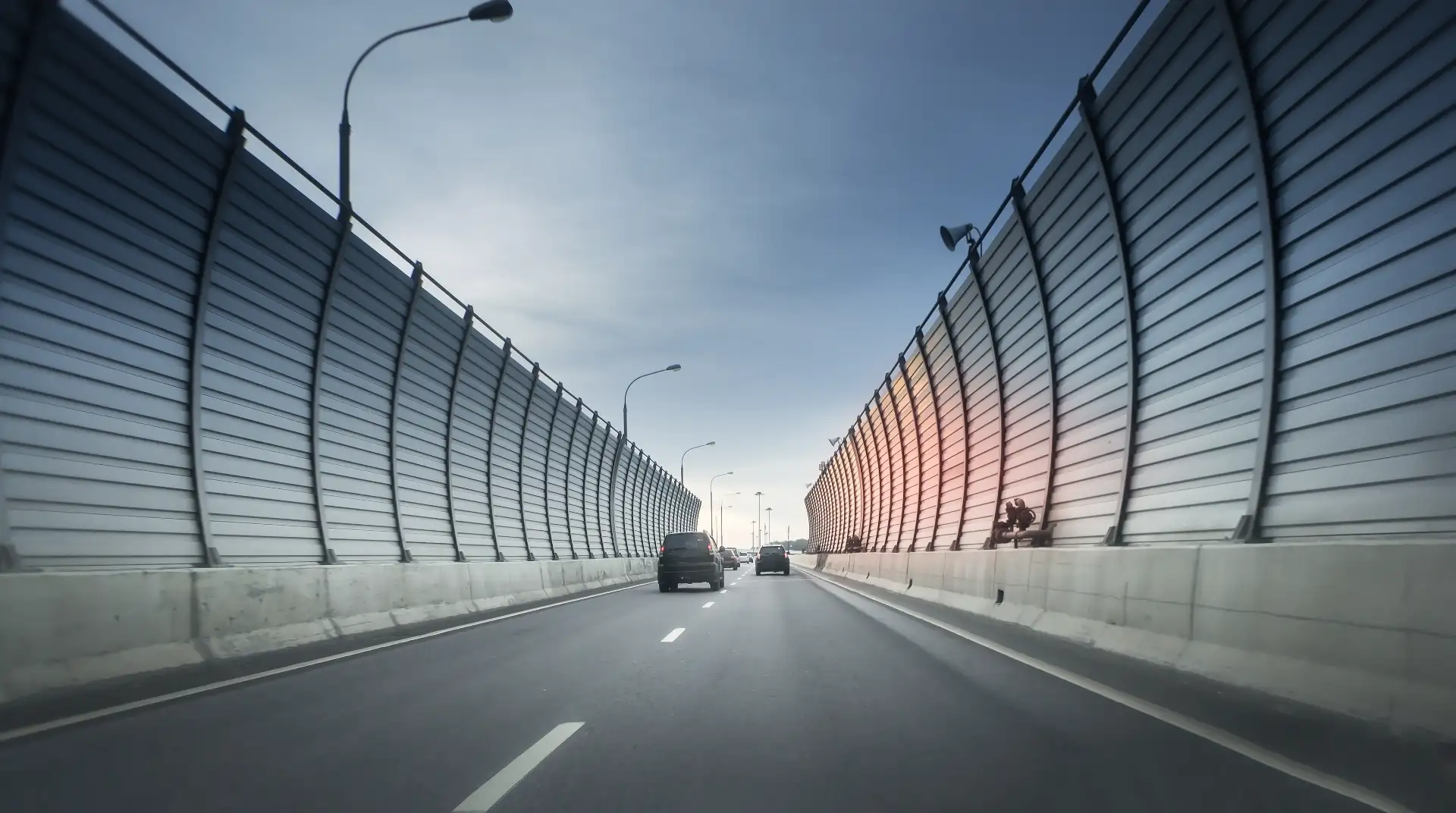
Barrier height is set by breaking the line of sight between the traffic source and the receiver — typically 3–6 m. A well-designed, gap-free barrier delivers roughly 10–15 dB insertion loss; even a 1% open gap sharply cuts performance, so joints must be sealed. Posts and panels are designed for wind load to IS 875 (Part 3).
Height and source–barrier–receiver geometry
A noise barrier reduces sound by breaking the line of sight between the source and the receiver and forcing the sound to diffract over its top edge. The bigger the path difference the sound must take over the barrier, the greater the attenuation — so performance is governed by geometry: the barrier height, and where it sits between the source and the receiver.
- Height — the single biggest lever. Raising the barrier increases the diffraction path and the attenuation; a barrier that barely breaks line of sight does little.
- Position — a barrier close to the source (or close to the receiver) works better than one stranded in the middle, because it blocks the line of sight more effectively.
- Length — a barrier must extend far enough along the road that sound does not simply travel around its ends to the receiver.
Traffic Noise & Barriers
- Traffic noise reduction from a barrier comes from diffraction over the top edge; the greater the path difference, the greater the insertion loss.
- A barrier only protects receivers whose line of sight to the traffic it interrupts — upper floors of tall buildings often see over a low barrier.
- Even a small continuous gap at the base or between panels can seriously reduce a barrier's real-world performance.
Base gaps, panel joints and absorptive vs reflective
The fastest way to ruin a well-sized barrier is to leak sound through it. A continuous gap at the base, open panel joints, or a low-mass panel let noise pass straight through and cap the achievable attenuation regardless of height. A noise barrier must be effectively imperforate along its whole run, with an adequate surface mass, and sealed at the base and joints.
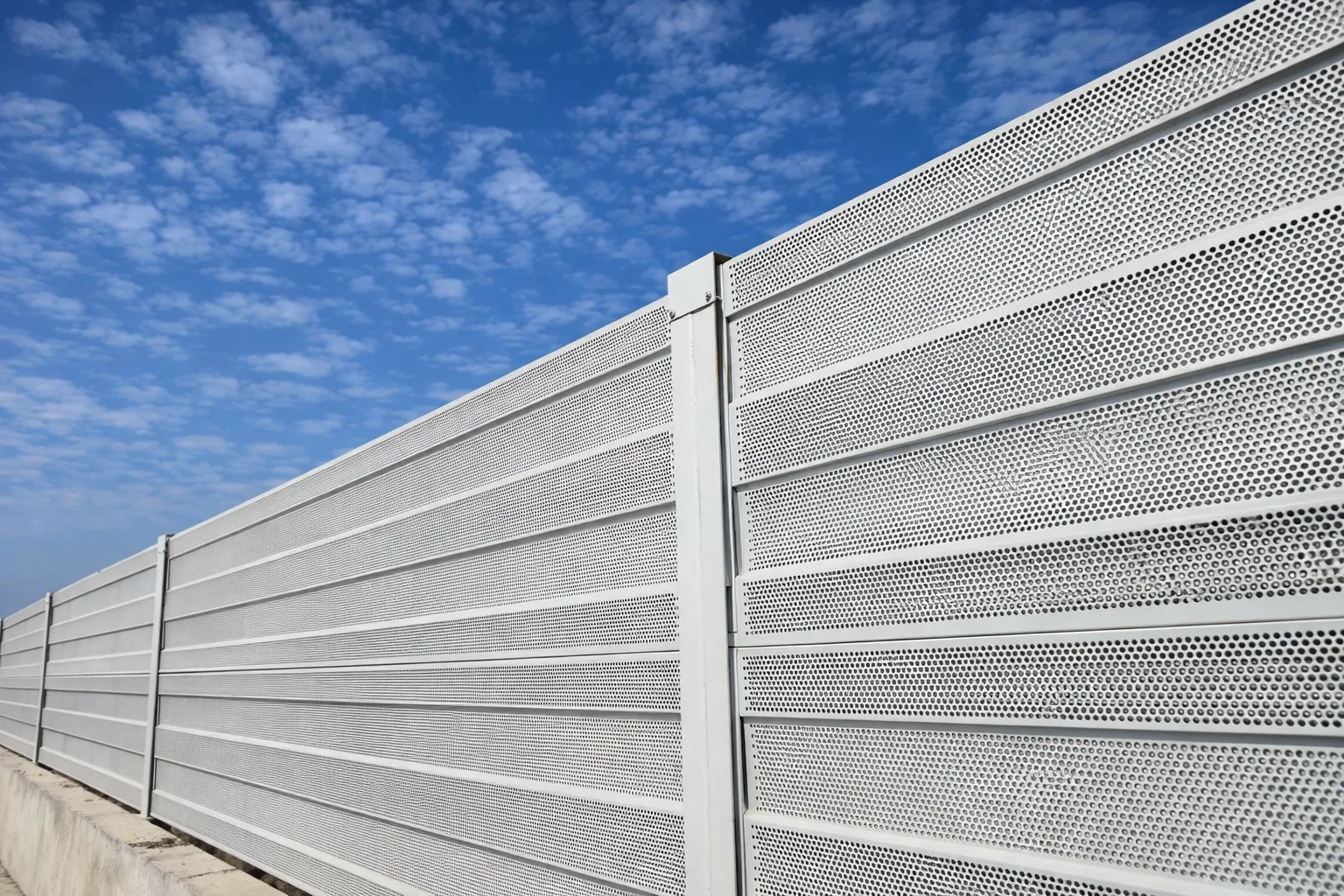
The barrier face matters too. A reflective barrier (metallic or concrete) bounces sound — which can raise levels on the opposite carriageway or reflect toward receivers on the far side. An absorptive barrier (perforated face over mineral-wool infill) soaks up incident sound, reducing reflections and helping in canyons and dual-carriageway situations. Transparent polycarbonate barriers are used on flyovers and where sightlines or daylight must be preserved.
| Face type | Behaviour | Where it fits |
|---|---|---|
| Absorptive (perforated + infill) | Absorbs incident sound | Dual carriageways, canyons, reflective surroundings |
| Reflective (metallic/concrete) | Reflects sound | Single-sided situations with no opposite receiver |
| Transparent (polycarbonate) | Reflective but see-through | Flyovers, scenic corridors, driver sightlines |
Height sets the ceiling on performance; gaps and low mass set the floor. A tall barrier with a leaky base delivers neither.
Wind load, post spacing and structure
A highway noise barrier is a large, solid sail. Its posts, panels and foundations must carry the design wind load for the location and height (to IS 875 / MoRTH requirements), which drives post section, post spacing and foundation size. On bridges, flyovers and elevated corridors the barrier also has to suit the deck's structural capacity and fixing details, and often uses lighter transparent panels to limit dead load and wind area.
KBG Group manufactures metallic, absorptive and transparent highway and railway noise barriers, engineered with post spacing and foundations for the site wind load. See the buyer-focused MoRTH & NHAI specification guide and, for equipment noise, the cladding vs enclosure vs barrier comparison.
Frequently Asked Questions
What determines how much a highway noise barrier reduces noise?
Mainly geometry: the barrier height and its position between source and receiver set the diffraction path over the top edge, and a longer path gives more attenuation. Length matters too, so sound does not travel around the ends.
Why do gaps below a noise barrier matter so much?
Sound leaks straight through any continuous gap or open joint, capping the barrier's real-world performance no matter how tall it is. A barrier must be effectively imperforate with adequate mass and sealed at the base and joints.
What is the difference between absorptive and reflective noise barriers?
A reflective barrier (metallic/concrete) bounces sound, which can raise levels on the opposite side; an absorptive barrier (perforated face over mineral wool) absorbs incident sound and reduces reflections, which helps on dual carriageways and in reflective surroundings.
How does wind load affect noise-barrier design?
A barrier is a solid sail, so its posts, panels and foundations must carry the design wind load for the site and height, which sets the post section, post spacing and foundation size — especially on bridges and elevated corridors.
Designing highway noise barriers for a corridor?
Our engineers review specifications and share test data at no cost. Typical response within one business day.