Why marine ventilation is a different discipline
A ventilation louver on a building and a ventilation louver on a ship look similar and do the opposite job under opposite conditions. The building louver lives in still air on a fixed facade; the marine louver lives in a salt-laden atmosphere, takes driving spray and green water, moves and vibrates with the vessel, and has to keep water out of a machinery or accommodation space in the worst sea state — while still passing the airflow the space needs. That combination is why marine ventilation is specified against a different set of rules from building HVAC.
On a vessel or offshore structure, exposed openings are governed by the framework of SOLAS, the International Convention on Load Lines and the rules of the applicable classification society — DNV, Lloyd's Register, ABS, Bureau Veritas or the Indian Register of Shipping (IRS). These decide where an opening may be, what integrity its closure must have, and how it is tested. The louver, hatch or door you supply is part of that closure — not a loose accessory bolted on afterwards.
- Corrosive atmosphere — constant salt exposure attacks ordinary steel and mild-alloy hardware; material and finish selection is the first decision, not the last.
- Water exclusion — the closure must meet a weathertight (or, in some locations, watertight) duty appropriate to its position on the vessel.
- Motion & vibration — fixings, gaskets and moving parts must survive continuous vessel motion without loosening or leaking.
- Airflow duty — machinery spaces still need their design air change; a closure that seals perfectly but chokes airflow is a different kind of failure.
Marine Environment & Corrosion
- Around 80–90% of world merchandise trade by volume is carried by sea (UNCTAD, Review of Maritime Transport), so marine equipment operates in near-continuous service.
- The marine atmosphere is one of the most aggressive corrosion environments there is, which is why aluminium alloys and stainless steel are preferred over ordinary carbon steel for exposed fittings.
- Salt-spray (fog) testing to ASTM B117 is a standard laboratory method used across the marine and coastal industries to compare corrosion resistance of finishes.
Materials and corrosion protection come first
In a marine specification, the material decision drives everything downstream — service life, maintenance interval, and whether the fitting survives at all. Marine-grade aluminium alloys are the workhorse because they combine low weight (critical on a vessel) with strong corrosion resistance in salt environments. The 5000-series alloys are valued for seawater resistance and the 6000-series for extruded structural profiles; both are finished for the environment rather than left bare.
| Decision | Marine-grade choice | Why it matters |
|---|---|---|
| Frame & blade material | Marine aluminium (5000 / 6000 series) | Light, seawater-resistant, formable into weather blades |
| Fasteners | Compatible stainless steel | Avoids the weak link that corrodes before the frame does |
| Finish | Anodising or marine coating | Adds a durable barrier against salt attack |
| Dissimilar-metal contact | Isolated / detailed out | Prevents galvanic corrosion at the joint |
| Verification | Salt-spray test (ASTM B117) | Compares finishes before they go to sea |
In marine hardware the fastener corrodes before the frame if it is the wrong grade — the weakest metal in the assembly sets the service life, not the strongest.
The subtle failure mode is galvanic corrosion: when two dissimilar metals are in electrical contact in a salty, wet environment, the less-noble metal corrodes preferentially. A beautifully finished aluminium louver held together with the wrong fasteners, or bolted directly to an incompatible structure, will fail at the joints long before the blades do. Good marine detailing isolates dissimilar metals and keeps the whole assembly galvanically compatible.
Integrating the louver, hatch and access opening
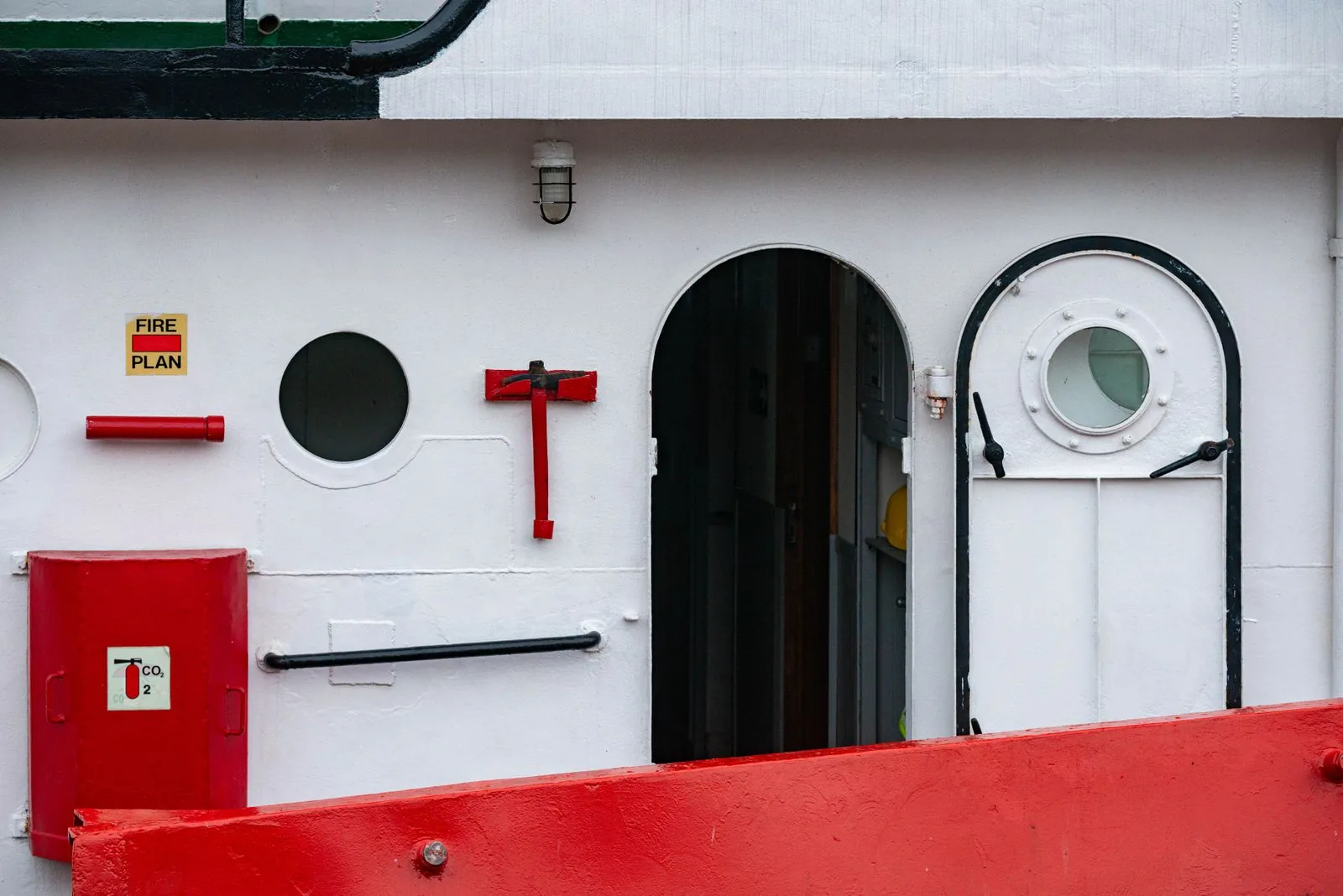
Every penetration through a deck or bulkhead is a closure to detail, weld, test and maintain, so reducing their number is a real design win. This is the case for integrated units that combine a weather louver with an access hatch or door in one framed opening: a space gets both airflow and personnel or equipment access through a single, properly detailed closure instead of two.
KBG Group's marine ventilation & access systems are built around exactly this idea — marine louvers with integrated hatches, weather louvers, intake and exhaust louvers, equipment and inspection hatches, and access doors, in marine-grade aluminium with corrosion-resistant finishes. For naval and defence programmes, these connect to our defence & marine solutions, where gas-tight dampers and jet-nozzle ventilation extend the same salt-durable engineering to warship and shipyard duty.
| Specification item | What to confirm |
|---|---|
| Location & duty | Weathertight vs watertight requirement for the opening's position on the vessel. |
| Airflow / free area | Effective free area meets the machinery or accommodation air-change design. |
| Material & finish | Marine aluminium alloy, compatible stainless fasteners, anodised or coated finish. |
| Closure type | Louver, louver-with-hatch, equipment/inspection hatch, or access door — matched to the opening's dual purpose. |
| Class compliance | Detailing and testing to the applicable classification-society rules and SOLAS / Load Line duty. |
| Verification | Salt-spray / finish evidence and any weathertightness testing the closure requires. |
The same weather-blade and free-area engineering that governs a marine louver also governs demanding shore applications — coastal data centres, desert intakes and high-humidity plant rooms. If your project sits at that boundary, the guides to data-centre louvers and acoustic enclosures and sand-trap louvers for desert and coastal sites cover the airflow-versus-weather trade-off in more depth.
Frequently Asked Questions
What makes a louver "marine-grade"?
A marine-grade louver is built from corrosion-resistant marine aluminium alloys (typically the 5000 and 6000 series), finished for salt exposure by anodising or a marine coating, and assembled with compatible stainless fasteners to avoid galvanic corrosion — while still passing the airflow the space needs.
What is the difference between weathertight and watertight?
Weathertight means water will not penetrate into the vessel in normal service, the standard for most exposed openings such as ventilation closures and access hatches. Watertight is a higher duty — the closure resists a head of water under pressure — used for openings in watertight boundaries. Each closure is specified to the duty its location requires.
How is corrosion controlled in marine ventilation systems?
Through material selection (marine aluminium and stainless steel), surface finishing (anodising or marine paint), and detailing that avoids dissimilar-metal contact driving galvanic corrosion. Salt-spray testing to ASTM B117 is commonly used to verify a finish before it goes to sea.
Can ventilation and access be combined in one opening?
Yes. Integrated units combine a weather louver with an access hatch or door in a single framed opening, so a space gets both airflow and access without cutting two separate penetrations — saving weight, simplifying weathertight detailing and reducing the number of closures to maintain.
Specifying ventilation for a vessel, offshore or coastal project?
Our engineers review requirements and share test data at no cost. Typical response within one business day.