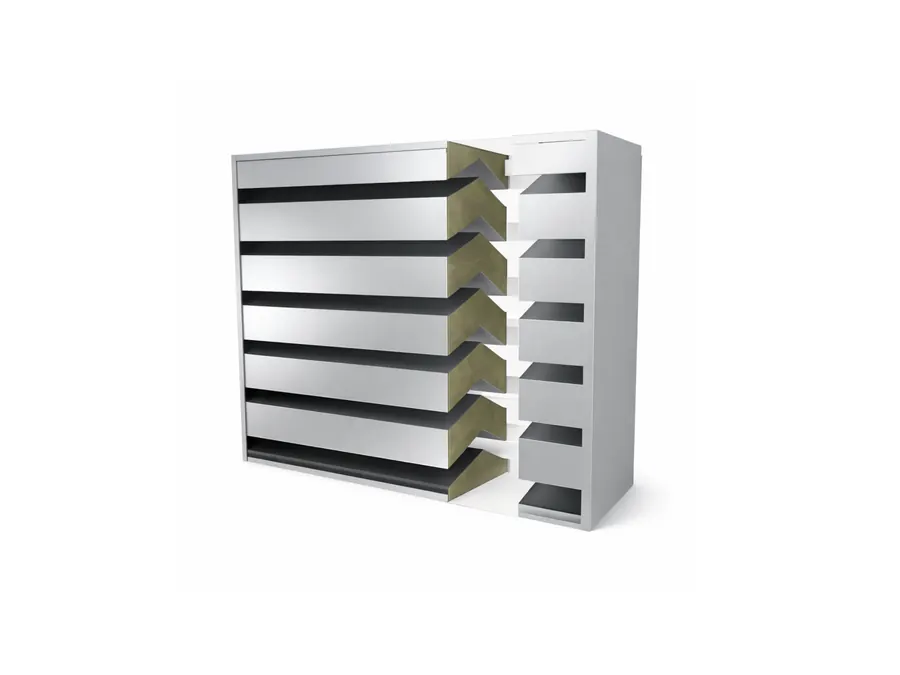
Three Ratings, Three Different Questions
STC, NRC and insertion loss are the three numbers that dominate acoustic specifications — and they are routinely confused. A spec that asks for a high NRC when it needs blocking, or an STC when it needs a field result, will not deliver quiet. The three ratings answer three genuinely different questions, and knowing which one your problem needs is most of the battle.
NRC — How Much a Surface Absorbs
NRC (Noise Reduction Coefficient) measures absorption — how much sound energy hitting a surface is soaked up rather than reflected. It runs from 0 (fully reflective) to 1 (fully absorptive), averaged across speech-range frequencies. NRC is the rating for controlling reverberation inside a space and for the absorptive linings inside enclosures and barriers. It says nothing about how much sound passes through a wall.
Use NRC for: reducing echo in a room, and specifying the absorptive fill inside acoustic enclosures, louvers and barrier panels. A high NRC does not make a good sound barrier.
STC — How Much a Partition Blocks
STC (Sound Transmission Class) measures transmission loss — how well a partition stops airborne sound from passing through it, as a single lab-tested number. Higher is better: a light partition might be STC 30, a well-built acoustic wall STC 50+. STC is the rating for walls, doors, panels and enclosure skins where the job is to keep sound on one side.
Insertion Loss — What You Actually Get On Site
Insertion loss is the real-world drop in noise level that a barrier or treatment produces after it is installed — the difference in decibels at the receiver with the barrier in place versus without it. Unlike STC (a lab number for a partition), insertion loss captures the whole installed situation: barrier height, gaps, flanking paths, distances and geometry. It is the figure that tells you whether the boundary limit will actually be met.
Lab ratings
- NRC — absorption of a surface (0–1)
- STC — transmission loss of a partition (single number)
- Measured in controlled test conditions
Field rating
- Insertion loss — real dB drop at the receiver
- Includes gaps, flanking, height and geometry
- The number that proves boundary compliance
Which Rating to Specify — and How
Match the rating to the job:
- Reducing echo / lining an enclosure? Specify NRC (e.g. absorptive fill NRC ≥ 0.9).
- Blocking sound through a wall, door or panel? Specify STC (e.g. enclosure skin STC ≥ 45).
- Meeting a boundary noise limit? Specify the required insertion loss at the receiver, or better, state the target level (e.g. ≤ 55 dB(A) at the boundary) and let it be engineered.
Best practice: specify the outcome — the boundary dB(A) limit — not just a component rating. That makes the supplier responsible for delivering a result, not just a data-sheet number.
Get the Rating Right the First Time
KBG Group designs acoustic enclosures, barriers and louvers to the rating that actually solves the problem — NRC linings, STC-rated skins and site insertion loss engineered to a boundary target. Tell us the source, the barrier and the limit, and we'll translate it into the right specification and quote a solution.
Frequently Asked Questions
What is the difference between STC and NRC?
NRC (Noise Reduction Coefficient) measures how much sound a surface absorbs (0 to 1) and is used to control echo and to line enclosures. STC (Sound Transmission Class) measures how well a partition blocks sound from passing through it. Absorption and blocking are different jobs — a high NRC does not make a good sound barrier.
What is insertion loss in acoustics?
Insertion loss is the real-world reduction in noise level (in dB) that a barrier or treatment produces after installation — the difference at the receiver with and without it. Unlike lab-based STC, it accounts for barrier height, gaps, flanking paths and geometry, so it is the figure that proves boundary compliance.
Which acoustic rating should I specify?
Use NRC for absorption (echo control, enclosure linings), STC for blocking through walls, doors and panels, and insertion loss (or a boundary dB(A) target) for meeting a site noise limit. Best practice is to specify the boundary outcome and let the solution be engineered to it.
Is a higher STC always better?
Higher STC means better airborne sound blocking, so for partitions and enclosure skins higher is generally better. But STC alone will not guarantee a field result — gaps and flanking paths can undermine a high-STC element, which is why insertion loss matters on site.
What NRC should absorptive material have?
For effective absorption inside enclosures, barriers and reverberant rooms, specify absorptive material with a high NRC — typically 0.85 to 1.0 — so most incident sound energy is soaked up rather than reflected.