How much noise does an acoustic louver reduce?
An acoustic louver's attenuation is stated as insertion loss in dB per octave band. A 300 mm-deep acoustic louver typically gives ~8–15 dB, and a 600 mm splitter bank up to ~20 dB, with the largest reduction at mid/high frequencies. Deeper chambers attenuate more but cut free area and raise pressure drop — so specify by the required dB per band against the allowable pressure drop.
How an acoustic louver works
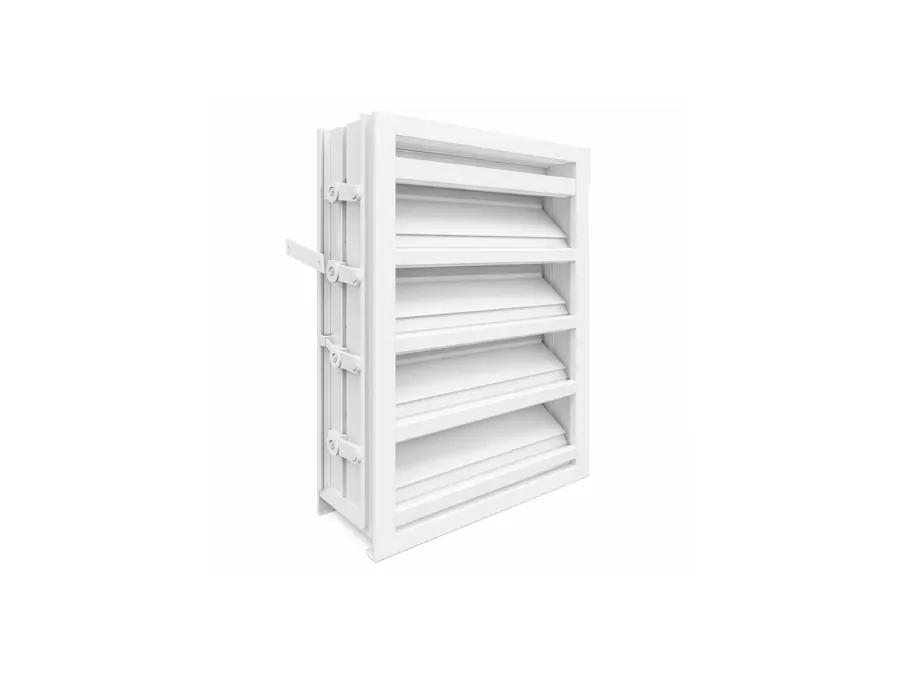
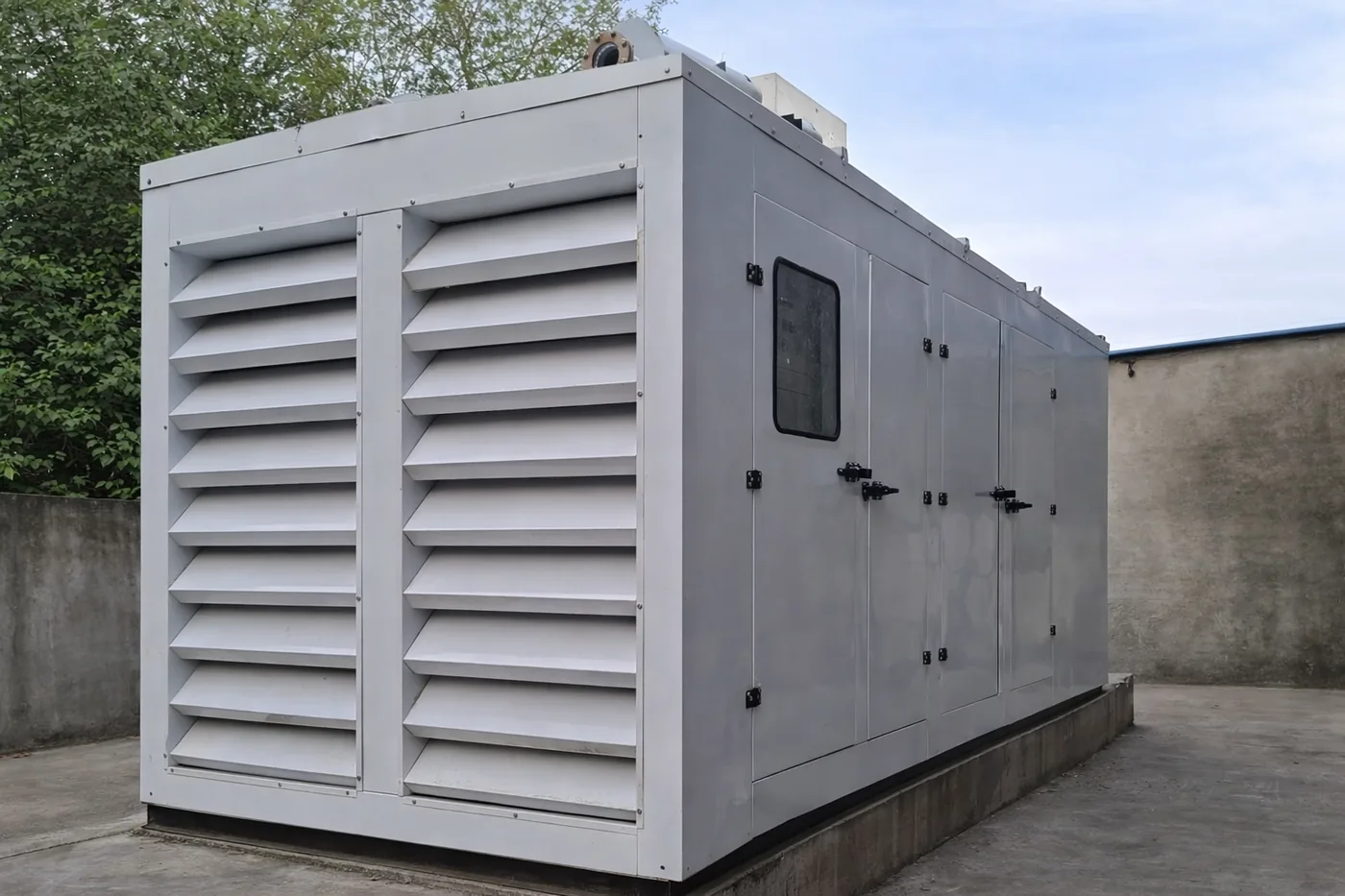
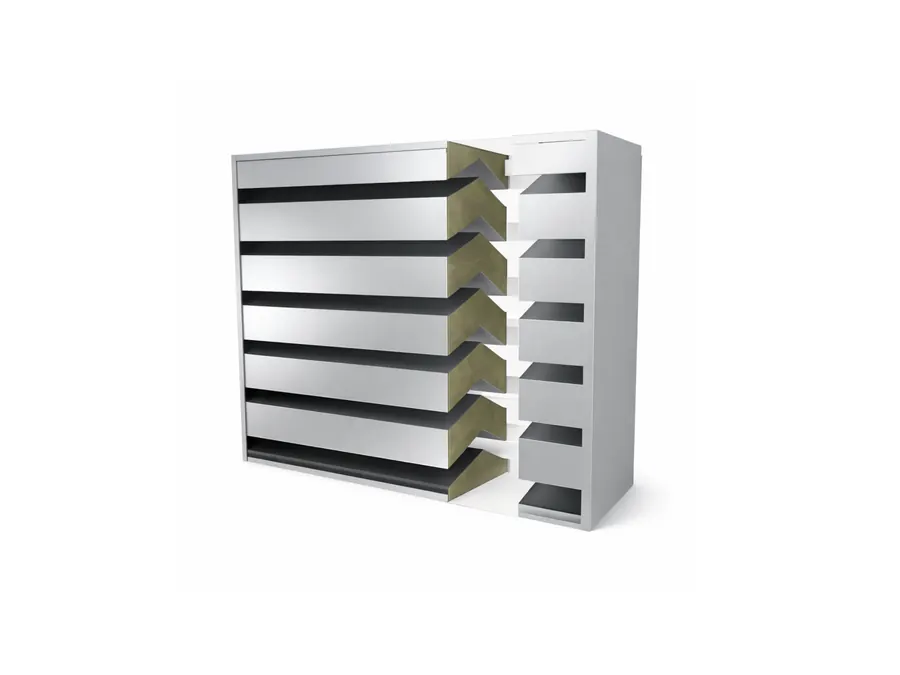
An acoustic louver is a deep louver whose blades are, in effect, small splitter silencers: aerofoil or chevron blades lined with sound-absorptive infill (mineral wool behind a perforated metal facing). Air passes between the blades; sound waves travelling with the air are absorbed as they reflect along the lined passages. The result is a single component that both ventilates and attenuates — the reason it is used on plant-room, DG and chiller openings where a solid wall is impossible.
- Ventilation — the louver still passes the air the plant needs, at a face velocity you select.
- Attenuation — absorptive blades reduce the noise breaking out through the opening.
- Weather — many acoustic louvers also provide a weather-louver duty on external openings.
Environmental Noise & Compliance
- Environmental (community) noise is a recognised health and nuisance issue, which is why boundary noise limits are enforced around industrial and power equipment.
- Acoustic louver performance is quantified as octave-band insertion loss, so a louver can be matched to the specific frequencies a source emits.
- Low-frequency noise is the hardest to attenuate because effective absorption needs depth comparable to the sound wavelength.
Insertion loss, transmission loss and octave bands
Two terms get confused. Transmission loss (TL) is a property of a material or partition. Insertion loss (IL) is the reduction in sound level actually achieved by inserting the louver into the opening — it is the in-situ number that matters, and it is what manufacturers publish for acoustic louvers. IL is quoted per octave band (typically 63 Hz to 8 kHz) because a louver attenuates far more at high frequency than at low.
This is why a single "dB reduction" figure is misleading. A DG set radiates strong low-frequency exhaust and engine noise; a louver with excellent 2 kHz IL but weak 63–125 Hz IL will disappoint against it. Match the louver's octave-band IL curve to the source's octave-band spectrum and the boundary limit — not to a headline number.
Ask for the octave-band insertion-loss curve, not a single dB figure. The low-frequency bands are where DG and chiller compliance is won or lost.
Depth, performance and the pressure-drop trade-off
The main lever on acoustic performance is depth. A 600 mm louver has longer lined passages than a 300 mm louver, so it delivers more insertion loss — especially in the difficult low-mid bands. But depth and the splitter blades that create the attenuation also restrict airflow, so a deeper, higher-IL louver has a higher pressure drop and less free area. Every acoustic-louver selection is this trade-off:
| If you need… | Choose | Cost |
|---|---|---|
| More noise reduction | Deeper louver (e.g. 600 mm) | Higher pressure drop, larger louver |
| Low pressure drop | Shallower louver (e.g. 300 mm) | Less insertion loss, esp. low frequency |
| Both | Larger face area at lower velocity | More facade / opening area |
When the required insertion loss exceeds what a louver can give within the available pressure and space, the answer shifts to an acoustic enclosure or attenuator instead. KBG Group manufactures acoustic louvers with published octave-band IL data and matching weather performance; see the acoustic louver specification guide and the chiller acoustic barrier guide for application detail.
Frequently Asked Questions
What is the difference between insertion loss and transmission loss?
Transmission loss is a property of a material or partition; insertion loss is the actual reduction in sound level achieved by inserting the louver into the opening. Insertion loss, quoted per octave band, is the in-situ figure that matters for acoustic louvers.
Why is octave-band data important for acoustic louvers?
Because a louver attenuates much more at high frequency than at low. Matching the louver's octave-band insertion-loss curve to the source spectrum (e.g. a DG set's strong low-frequency noise) and the boundary limit is what determines compliance — a single dB figure hides this.
How does a 600 mm acoustic louver compare with a 300 mm one?
The 600 mm louver has longer lined passages, so it gives more insertion loss, especially at low-mid frequencies — but it also has a higher pressure drop and less free area. Depth is the main trade-off between attenuation and airflow.
When should I use an acoustic enclosure instead of an acoustic louver?
When the required insertion loss is more than a louver can provide within the available pressure drop and space — typically for high noise reduction around DG sets or industrial equipment — a full acoustic enclosure or attenuator is the better solution.
Selecting acoustic louvers for a DG or chiller yard?
Our engineers review specifications and share test data at no cost. Typical response within one business day.