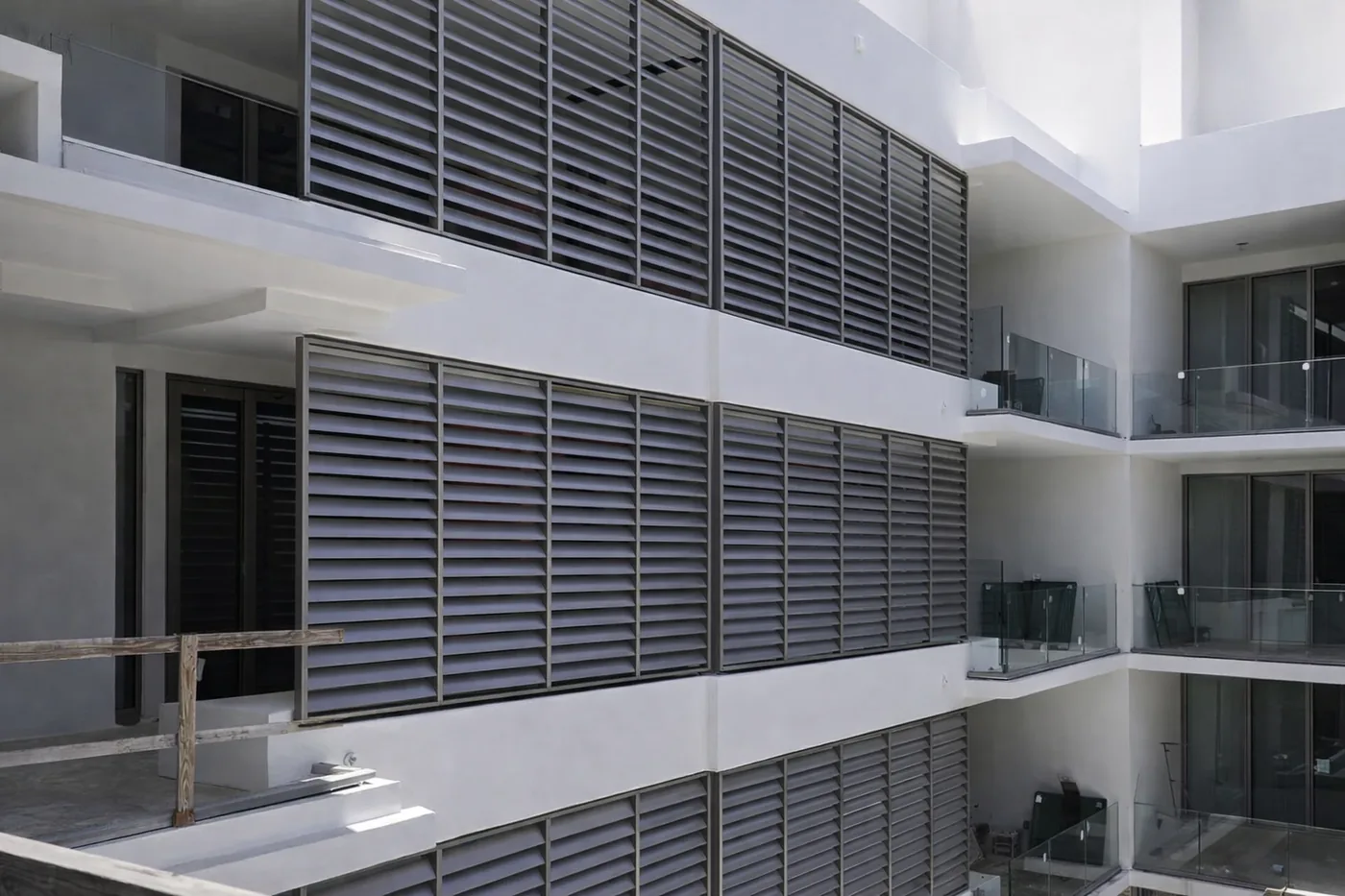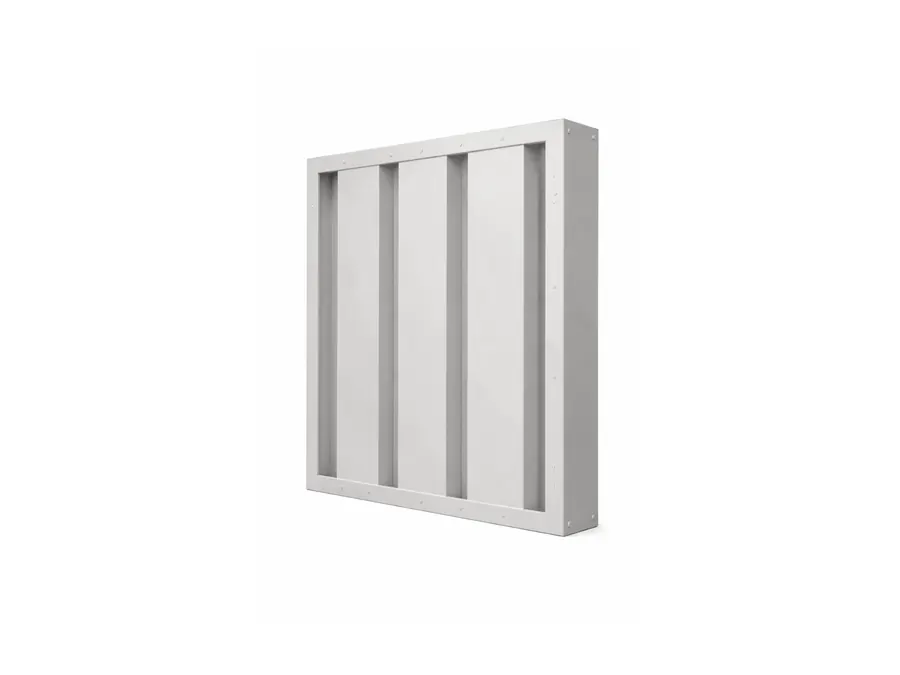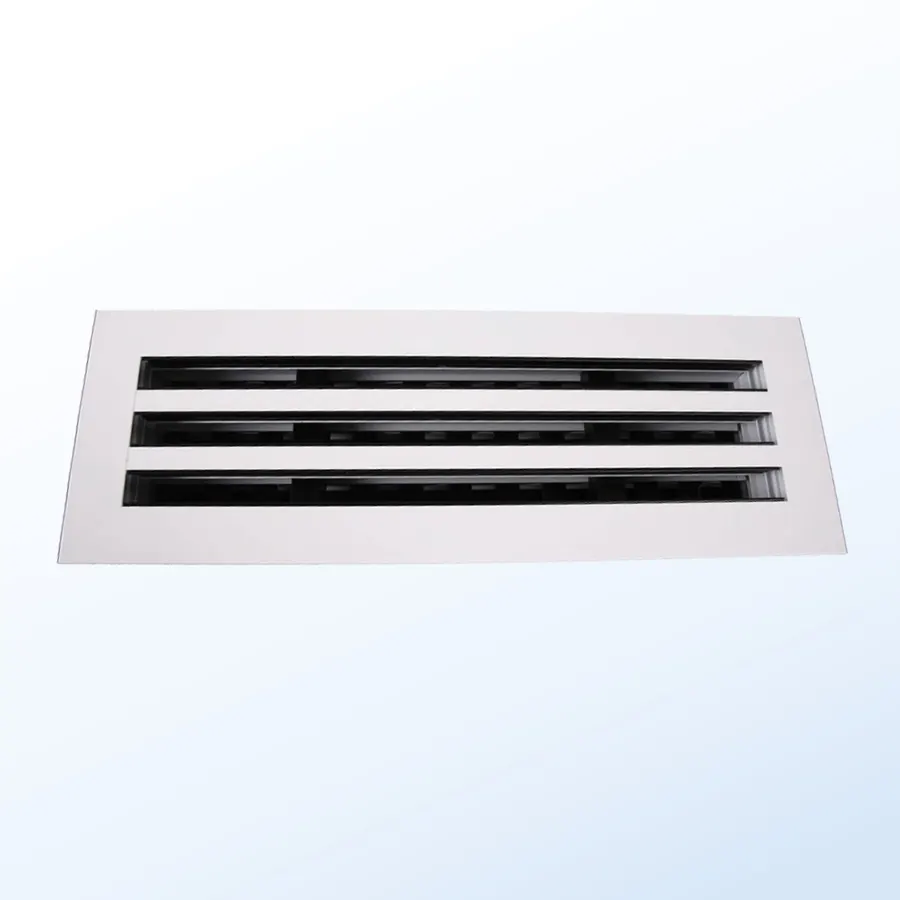
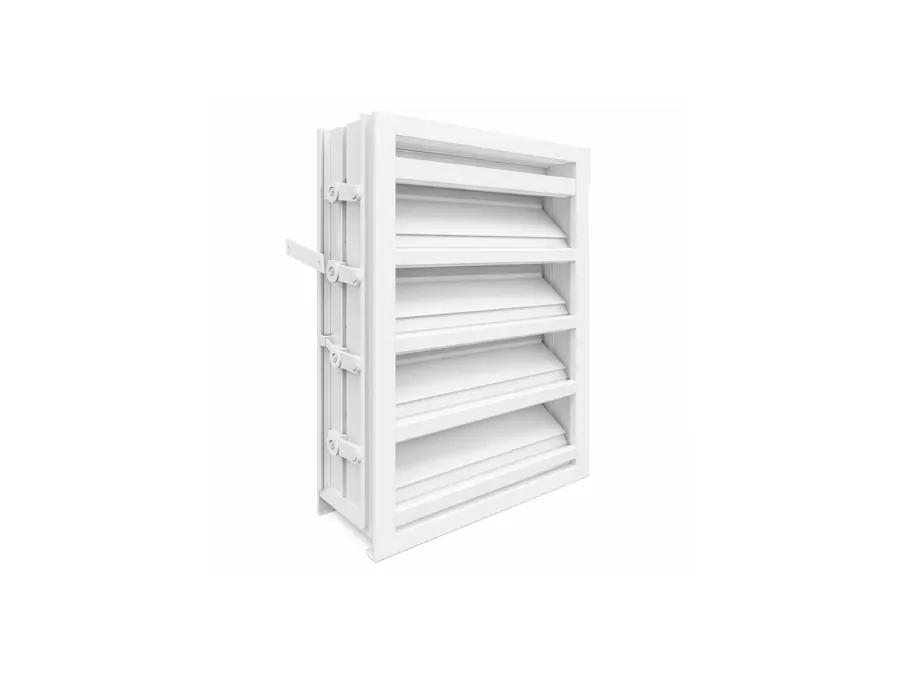
How do you select a performance ventilation louver?
Match three tested parameters to your design face velocity: free area, water-rejection class (BS EN 13030 Class A–D) and pressure drop. Single-bank weather louvres give ~45–55% free area but reject less water; deep performance banks reach Class A (near-zero penetration up to ~3.5 m/s core velocity) at the cost of free area and higher pressure drop. Size from the manufacturer's lab-tested data per model, not catalogue estimates.
What makes a louver a "performance" louver
A performance louver and an ordinary fabricated louver can look identical on a facade and behave completely differently in a storm. The difference is not the appearance — it is the test data behind it. A performance louver has published, third-party-tested curves for how much air it passes, how much pressure it costs to pass that air, and how much rain it keeps out at a given speed. An untested louver has none of that; you find out how it performs the first time it rains hard with the fan running.
The governing test methods are EN 13030 (the European louvre standard, widely referenced in India and the GCC) and AMCA Standard 500-L (the US method). Both put a louver in a rig and measure the same physics: air performance (pressure drop and an aerodynamic coefficient) and water rejection (what fraction of driving rain is stopped at a series of face velocities). When a consultant asks for a "tested" or "performance" louver, this is the data being demanded.
- Air performance — pressure drop versus velocity, plus a discharge/entry loss coefficient.
- Water rejection — penetration effectiveness measured at rising face velocities, reported as a class.
- Free area — the effective (aerodynamic) open area, not just the geometric gap between blades.
Louvers, Rain & Ventilation
- Wind-driven rain is one of the most common causes of water ingress at building intakes, which is why weather-louver water performance is tested rather than assumed.
- The two internationally recognised louvre test methods — EN 13030 and AMCA 500-L — let performance from different manufacturers be compared on the same basis.
- Louver water rejection falls as face velocity rises, so a louver is only "Class A" up to the velocity at which it was tested and rated.
The three numbers that decide the selection
A defensible louver selection rests on three published figures, read together. Size on airflow alone and you can hit the volume while flooding the plant room or starving the fan.
- Face velocity — the airflow divided by the louver's face (or core) area. It is the master variable: water penetration and pressure drop both climb with it. Most weather louvers are selected to sit at or below the velocity at which their water class holds.
- Pressure drop — the resistance the louver adds, read from the manufacturer's curve at your design velocity. It has to fit the fan's available static pressure with margin.
- Water-penetration class — how much driving rain the louver stops at that velocity, reported as an EN 13030 class (A is best). A louver rated Class A at 1.0 m/s is not Class A at 3.0 m/s.
| Design lever | What it does | Trade-off |
|---|---|---|
| Lower face velocity | Improves water rejection and cuts pressure drop | Needs a larger (more expensive) louver |
| Drainable blades | Channel intercepted water away, holding class at higher velocity | Slightly different blade geometry / cost |
| Deeper blade section | Improves rain defence | Higher pressure drop and weight |
| Adding bird/insect mesh | Keeps out birds and insects | Reduces effective free area, raises pressure drop |
Water rejection and pressure drop both rise with face velocity — so the whole selection is really a decision about how big the louver has to be to keep velocity in the safe band.
This is why two louvers of the same overall size can quote completely different pressure drops and water classes: the blade profile, pitch, depth and whether the blades are drainable all change the physics behind the same rectangle of aluminium.
Free area, effective free area and sizing
The most misread number on a louver datasheet is free area. The geometric free area is simply the open gap between blades. The effective (aerodynamic) free area is smaller — it accounts for the turbulence and contraction as air squeezes through, and it is the number that actually governs airflow and velocity. A consultant comparing louvers should compare effective free area, or better, compare pressure drop at the same airflow.
To size a louver: take the design airflow, choose a target face velocity that keeps the louver within its water-penetration class, and solve for the required core area. On large openings the result may need structural mullions and intermediate supports to carry wind load — a real louver is also a piece of facade structure, not just an air path.
KBG Group manufactures tested aluminium performance ventilation louvers with published air and water data, drainable and storm-resistant options, and mullion-supported large assemblies. For the desert and coastal intake case, our guide to sand-trap louvers covers inertial dust separation, and the companion piece on EN 13030 and Class A certified louvers shows how to read the test report itself.
Frequently Asked Questions
What is a performance louver?
A performance louver is one with published, third-party-tested air and water data to EN 13030 or AMCA 500-L — pressure drop against velocity and a water-penetration class — rather than a fabricated louver with no verified performance.
How does face velocity affect a louver?
Both water penetration and pressure drop rise with face velocity. A louver is rated to a water class only up to a defined velocity, so selections keep the design face velocity at or below that point, usually by choosing a large enough louver.
What is the difference between free area and effective free area?
Geometric free area is the open gap between blades; effective (aerodynamic) free area is smaller and accounts for turbulence and contraction through the louver. Effective free area — or pressure drop at equal airflow — is the fair basis for comparison.
Do drainable louvers perform better in heavy rain?
Generally yes. Drainable blades have channels that carry intercepted water down and out, so they hold their water-penetration class at higher face velocities than equivalent non-drainable louvers, which matters in monsoon and storm conditions.
Specifying performance louvers for a project?
Our engineers review specifications and share test data at no cost. Typical response within one business day.
Tested vs untested louvers: why certification matters →