Where rail noise actually comes from
Highway barrier design is mature in India, backed by MoRTH and IRC practice, and it is natural to carry that experience onto a rail or metro corridor. The carry-over works less well than expected, because the source is different in three ways.
Source height. At normal operating speeds the dominant rail noise mechanism is wheel-rail interaction — rolling noise generated essentially at rail level. Road noise, by contrast, combines tyre-road contact at ground level with engine, exhaust and body sources distributed up to the height of a truck stack. A highway barrier has to intercept a tall band of sources; a rail barrier is dealing with one that is low and well-defined. That is a significant advantage, if the design exploits it.
Spectrum. Wheel-rail rolling noise has its own frequency character, and a corridor can carry additional components: curve squeal where radii are tight, impact noise at joints and crossings, and on viaducts structure-radiated noise where the deck itself is excited and radiates. That last one is not an airborne path at all, and a barrier does nothing about it — it is addressed in the track form and structure, through rail fastening, resilient track support and deck design.
Time pattern. Road traffic is a quasi-continuous stream; rail is discrete passes. Both are assessed as Leq over a period, but the perceptual and complaint character differs — intermittent events against a quiet night background are noticed in a way a steady hum is not.
The compliance framework is the same: the zone limits in the Noise Pollution (Regulation and Control) Rules, 2000, with the night-time figure — 45 dB(A) residential — usually binding on a metro that runs early and late.
Why Rail Barriers Are Designed Differently
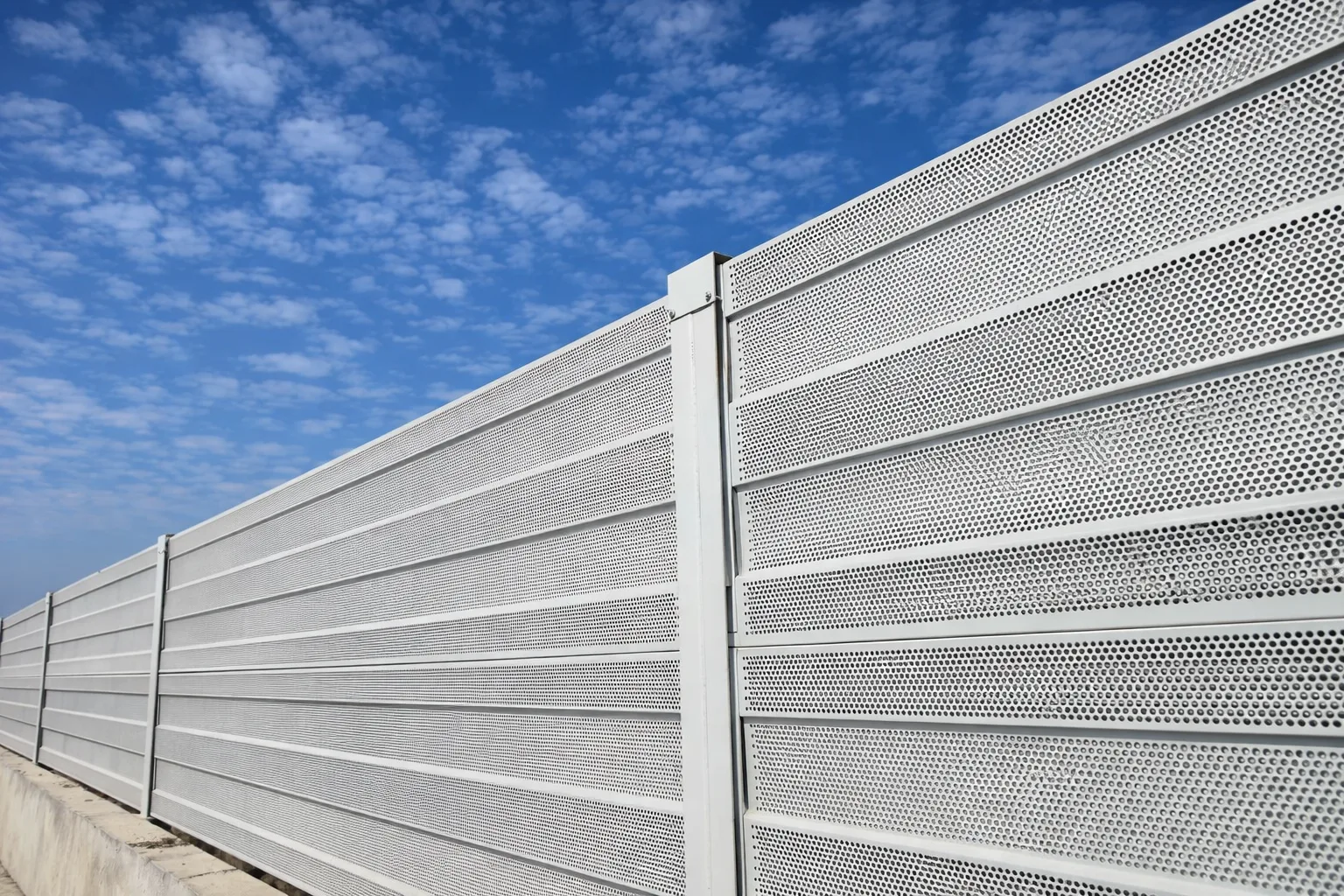
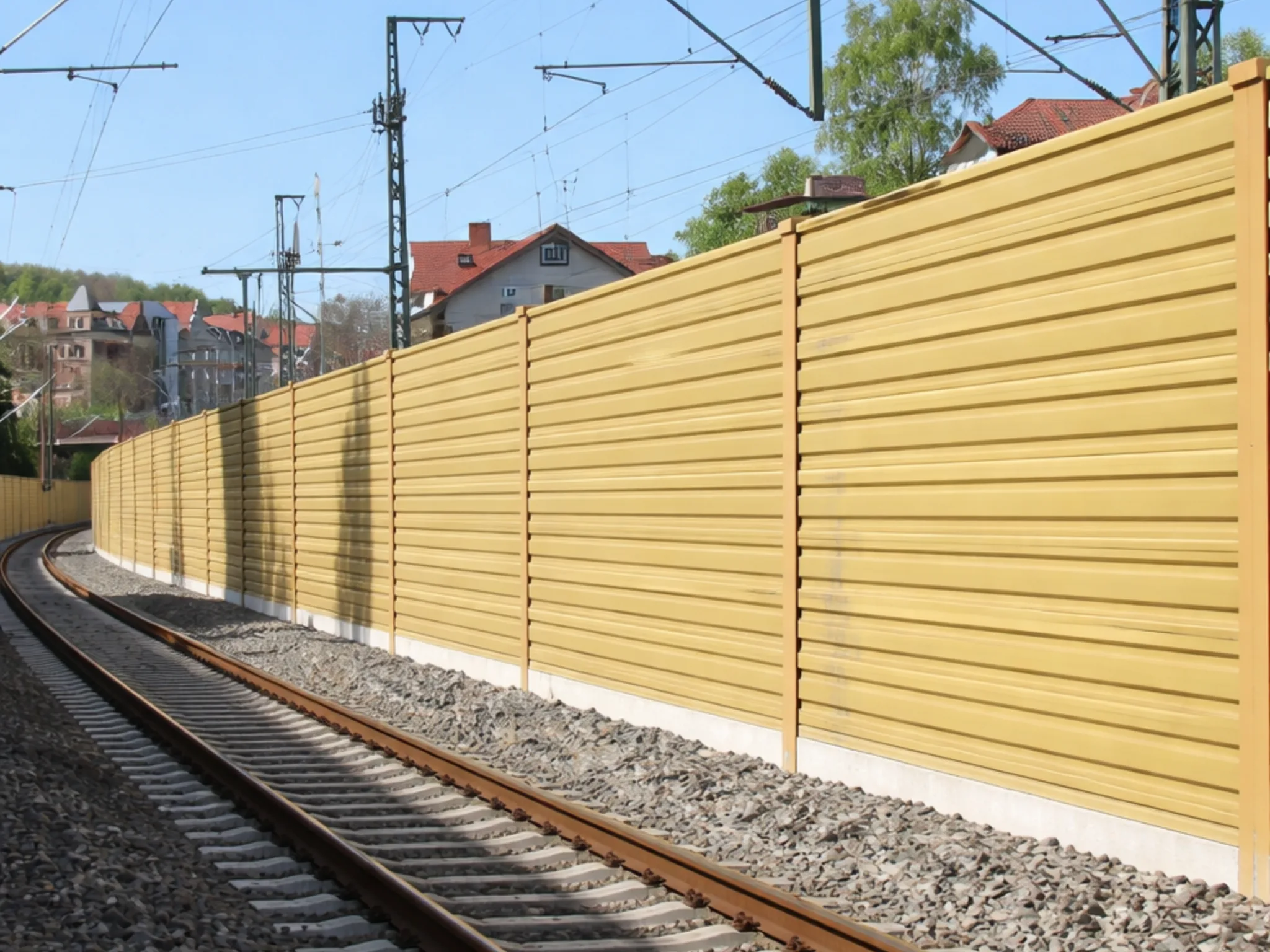
- Rail rolling noise originates essentially at rail level, so a barrier close to the track intercepts a low, well-defined source rather than a tall band.
- Barrier benefit depends on the diffraction path over the top edge relative to the direct path, so proximity to a low source substitutes for height.
- Structure-radiated noise from an excited viaduct deck is not an airborne path and is addressed in track form and structure, not by barriers.
Why proximity beats height on a rail corridor
A barrier works by forcing sound to diffract over its top edge, lengthening the path to the receiver relative to the direct line. The benefit therefore depends on the geometry of source, barrier edge and receiver — not on the barrier's area or mass, beyond what is needed to stop transmission through it.
That geometry rewards being close to the source. A barrier a short distance from a low source blocks the direct path with modest height, because the diffraction detour is large relative to the direct path. The same acoustic result from a barrier set further back needs considerably more height.
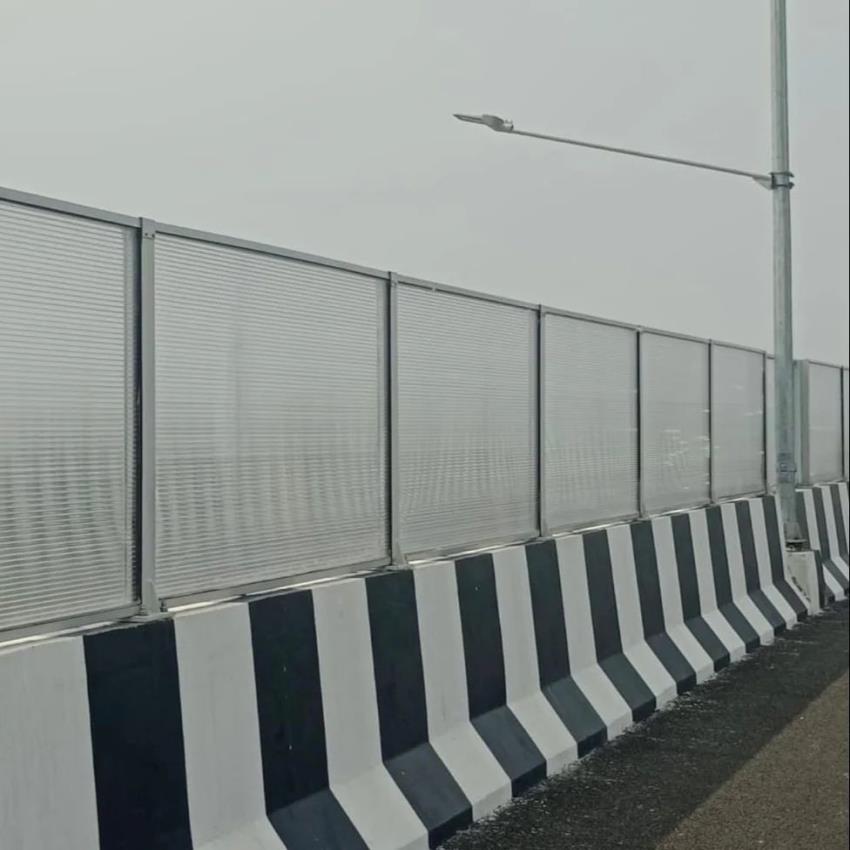
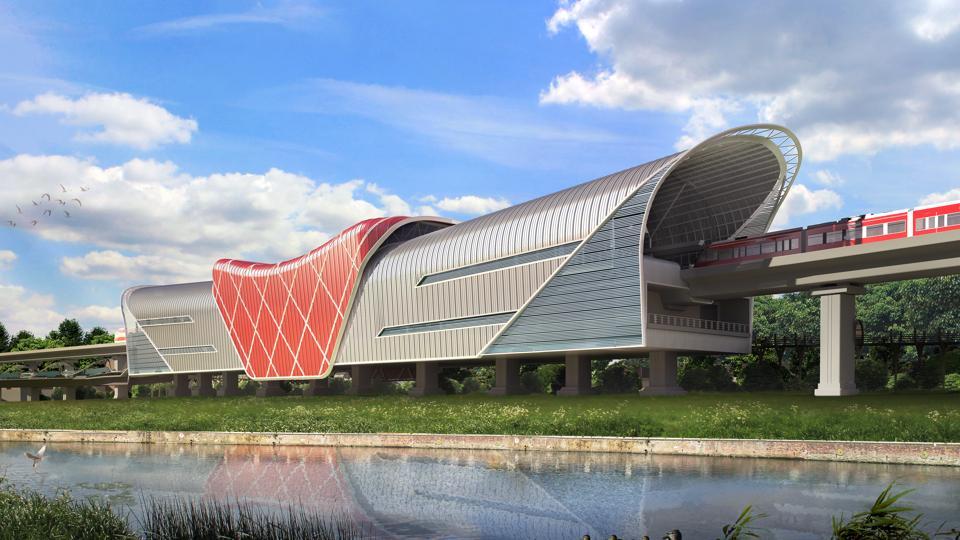
On a rail viaduct this is exactly the available move: the barrier can sit on the parapet, close to the track, intercepting a source at rail level from a short distance. This is why a relatively low parapet-mounted barrier on a metro viaduct can be effective where an equivalent highway barrier would look under-scaled. The practical consequences:
- Position first, height second. Get the barrier as close to the track as clearances permit before increasing height.
- Gaps are expensive. As with any barrier, a gap leaks disproportionately — the geometric advantage is lost wherever the line of sight reopens. The mechanism is covered in barrier height, gaps and wind.
- Absorptive facing towards the track. With barriers on both sides, the space between becomes a reflective channel; an absorptive face reduces the build-up and recovers part of each barrier's benefit.
- Check for receivers above. On an elevated structure, a receiver in an upper-floor apartment may see over the barrier entirely, in which case barrier height is doing nothing for them and the geometry has to be re-examined.
On a viaduct, the cheapest decibels come from moving the barrier closer to the rail, not from making it taller.
Viaduct constraints: the structure decides
On a metro viaduct the acoustic design is usually the junior partner to the structural one, for good reason.
Wind load at height. Design wind pressure under IS 875 (Part 3) rises with height, and a barrier is a solid sail at the top of an elevated structure. Its load is carried by the parapet and into the deck, as a moment at the worst possible location. On a new viaduct this is designed in; on an existing one, the structural capacity available for added load frequently sets the maximum barrier height — meaning the acoustic target has to be met within a structural envelope, or not met at all by barriers.
Dead load and dynamic behaviour. Added mass along a span affects the structure's dynamics. Barrier systems for viaducts are therefore designed to be light for their acoustic performance, which is a different optimisation from a ground-mounted barrier where mass is cheap.
Fixing into the parapet. Post fixings are a durability and waterproofing detail as much as a structural one. They penetrate a structure exposed to weather for decades, and corrosion at the fixing is a common long-term failure. This argues for aluminium systems with appropriately specified stainless fixings and isolation between dissimilar metals.
Access and the operating railway. Installation and maintenance happen in short possessions beside live track, or above a road. That drives the design towards:
- Modular panels installable quickly with minimal plant.
- Single-side access for installation and replacement, since there is often no track-side access at all.
- Individually replaceable panels, so one damaged unit does not require dismantling a run.
- Lightweight handling, because what cannot be lifted in a possession window cannot be installed.
Specifying a rail or viaduct barrier
What a specification should settle, in order:
| Decision | Driven by | Common error |
|---|---|---|
| Barrier position | Track clearances — as close as permitted | Setting it back and adding height instead |
| Height | Geometry to the governing receiver | Uniform height along the whole run |
| Absorptive vs reflective | Barriers both sides? Receiver opposite? | Reflective both sides, benefit lost |
| Panel mass | Transmission loss required | Over-massing while leaving gaps |
| Transparency | Views, daylight, consent conditions | Clear panels with no bird markers |
| Structural load | IS 875 (Part 3) at height; parapet capacity | Acoustic design fixed before structural check |
| Replaceability | Possession access, single-side working | Systems needing track-side access |
Two closing points. First, where views or daylight matter — and on urban viaducts beside housing they usually do — a hybrid of absorptive opaque panels low and transparent panels above is often the right arrangement, with bird-strike markers specified from the outset; see transparent noise barriers. Second, barriers do not address structure-radiated noise from the deck or depot-related noise at the corridor's ends; for the latter see metro depot ventilation and noise control, and for the baseline survey that makes any of this verifiable, noise studies for infrastructure projects.
KBG Group manufactures rail and viaduct noise barrier systems in absorptive metal, transparent polycarbonate and hybrid configurations, designed for parapet mounting, single-side installation and individual panel replacement, with framing engineered to the IS 875 wind pressure at deck level. As part of our metro rail systems capability we can coordinate barrier design with the ventilation and facade packages on the same corridor.
Frequently Asked Questions
How is rail noise different from highway noise?
The dominant source sits at a different height and has a different spectrum. At normal operating speeds, rail noise is dominated by wheel-rail interaction originating essentially at rail level, whereas road noise comes from a mix of tyre-road contact and engine and exhaust sources distributed over a greater height. Rail noise is also more intermittent — discrete train passes rather than a continuous traffic stream.
Why are rail noise barriers often lower than highway barriers?
Because the source is lower and closer. Barrier effectiveness depends on how far the sound has to diffract around the top edge relative to the direct path, so a barrier placed very close to a low source can achieve with modest height what a distant barrier would need much more height to match. On a viaduct the barrier can sit close to the track, which is why a relatively low parapet-mounted barrier can be effective.
What makes viaduct barriers structurally difficult?
The barrier adds wind load and dead load at the top of an elevated structure, where both are most onerous and where the structure was designed with specific allowances. Wind pressure under IS 875 (Part 3) increases with height, and the barrier's moment is carried by the parapet and deck. On an existing viaduct the available capacity frequently limits barrier height, so the acoustic design has to work within a structural envelope rather than the reverse.
Do viaduct noise barriers need absorptive panels?
Usually on the track-facing side, yes. Barriers on both sides of a viaduct create a reflective channel in which sound bounces between them before escaping, which reduces the benefit of each. An absorptive face towards the track reduces that build-up. It also helps where a barrier faces a building across the corridor, since a reflective barrier can raise levels at that receiver while reducing them behind itself.
Specifying barriers for a metro viaduct or rail corridor?
Our engineers review specifications and share test data at no cost. Typical response within one business day.