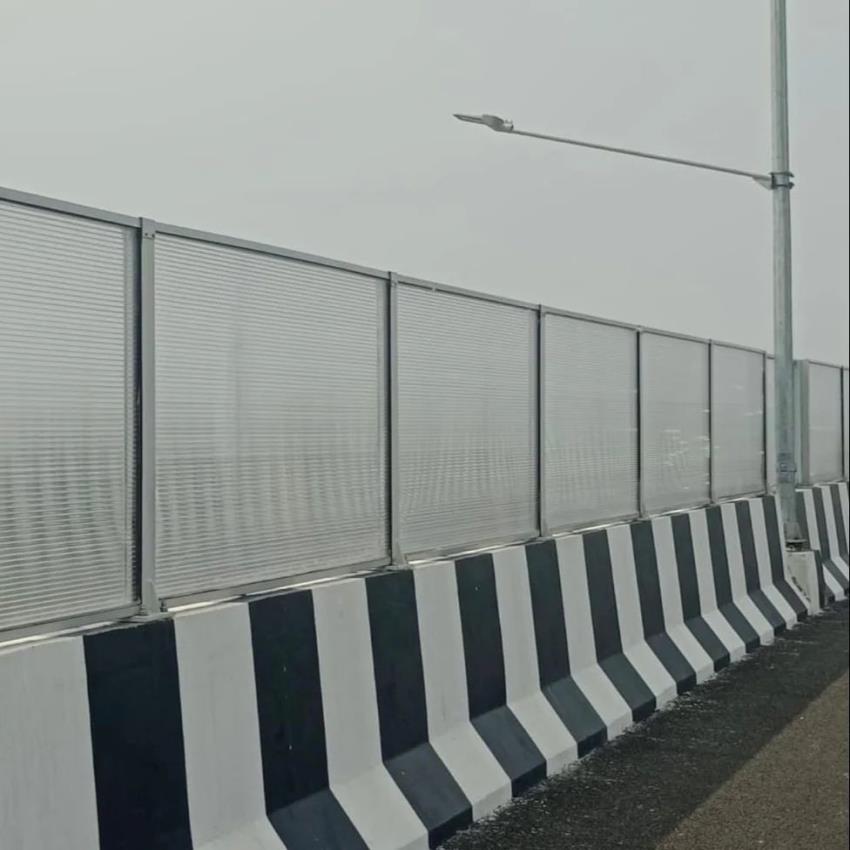
Why transparent at all
Transparent noise barriers cost more than opaque ones, need more maintenance, and bring failure modes opaque panels do not have. They are nonetheless the right answer on a significant minority of schemes, and the reasons are almost never acoustic:
- Driver and passenger experience. A long run of solid barrier produces a tunnel effect — enclosure, loss of orientation, and a monotonous visual field. Transparency keeps the journey legible.
- Daylight for adjoining property. A tall barrier close to housing or a footway can take significant daylight from ground-floor rooms. A transparent upper section returns it.
- Sightlines and surveillance. Solid barriers create concealed space. Transparency preserves natural surveillance along footways and service roads, which is a safety argument as much as a design one.
- Views worth keeping. On elevated and viaduct structures, the view is often the asset — for residents facing the structure as much as for people travelling on it.
- Planning and heritage conditions. Sometimes transparency is simply the condition on which consent was granted, in which case it is not a trade-off to be optimised.
The useful way to frame it: a transparent barrier is bought to reduce the non-acoustic cost of the acoustic solution. That is a real benefit, and it is worth paying for when the alternative would be an unacceptable barrier — or no barrier at all. It is not worth paying for where nobody sees the thing.
What Governs a Transparent Panel
- Transmission loss through a barrier panel is governed principally by surface mass, so transparency itself costs little acoustically at comparable mass.
- Transparent panels are reflective rather than absorptive, which matters in cuttings and between parallel barriers where reflections accumulate.
- Panel and frame must carry the design wind pressure from IS 875 (Part 3), with the frame accommodating the greater thermal movement of polymer panels.
Acoustics: it is mass, not opacity
The most common misconception is that a transparent barrier must be acoustically weaker because you can see through it. For transmission — sound passing through the panel — that is not how it works. Transmission loss through a solid panel is governed principally by its surface mass, and a transparent panel of comparable mass per unit area performs comparably. Transparency is an optical property; the acoustics care about kilograms per square metre.
Where transparent panels genuinely differ is absorption. They are hard and reflective. Many opaque barrier systems can be built with an absorptive face towards the source — perforated metal over mineral infill, for instance — which does something a transparent panel cannot:
- In a cutting or below a retaining wall, reflections build up and an absorptive face reduces the accumulation.
- Between parallel barriers on both sides of a carriageway, sound reflects back and forth; two reflective barriers perform worse than two absorptive ones.
- Where a barrier faces a building across the road, a reflective barrier can increase levels at that building while reducing them behind itself.
This leads to the arrangement most schemes should actually use: absorptive opaque panels at the lower levels, transparent panels above. The lower section handles the absorption where reflections matter and where the acoustic benefit is greatest; the upper section returns daylight and view. Our guides to barrier height, gaps and wind and STC, NRC and insertion loss cover how the geometry and the ratings interact.
You can see through it, so it must be acoustically weaker. Transmission loss depends on mass, not on whether light gets past.
Durability, and the bird strike problem
Two materials dominate, with genuinely different failure modes.
| Acrylic (PMMA) | Polycarbonate (PC) | |
|---|---|---|
| Optical clarity over time | Excellent, resists yellowing | Good if UV-stabilised; can yellow |
| Impact resistance | Lower — brittle | Very high |
| Abrasion / scratch | Moderate | Lower unless hard-coated |
| Best suited to | Long clear runs, low vandalism risk | Urban, vandalism or debris exposure |
| Main risk | Cracking from impact | Surface degradation and hazing |
Neither is simply better. Acrylic keeps looking good but breaks; polycarbonate survives almost anything but can stop looking good. The selection should follow the dominant risk at the specific location — and on urban schemes with public access, impact resistance usually wins.
Bird strike is not an optional consideration. A clear, unmarked panel is invisible to birds, and collisions with transparent barriers are a recognised problem. The mitigation is visual markers — vertical striping, printed patterns or fritting at a spacing birds perceive as an obstacle — incorporated into or applied to the panel. Two practical points: markers are far cheaper and more effective when specified from the start than retrofitted, and they should be part of the standard specification for any scheme with substantial clear area, not a line item to be value-engineered away.
The third durability factor is cleaning. Soiling, road film and abrasion progressively remove the transparency the barrier was bought for. A transparent barrier with no cleaning regime and no access to clean it has, within a few years, the maintenance cost of a transparent barrier and the appearance of a poor opaque one.
Detailing and whole-life cost
Transparent panels put more demand on the frame than opaque ones, for three reasons.
Thermal movement. Polymer panels expand and contract more than metal or concrete. The frame has to allow that movement; a panel restrained at its edges will craze, bow or crack. Glazing pockets, gaskets and edge clearances are the critical details, and they are where most transparent barrier failures originate.
Wind load, and acoustic sealing at the same time. The panel and frame carry the design wind pressure from IS 875 (Part 3), which on an elevated or viaduct barrier is substantial. At the same time, every gap is an acoustic leak — a barrier's performance is set by its weakest path, and an unsealed joint undoes panel performance however good the panel is. Gaskets therefore have to seal acoustically while permitting movement, which is a harder specification than it looks.
Replaceability. Transparent panels get damaged, and they will need replacing more often than opaque ones. A system where a single panel can be removed and replaced from one side, without dismantling neighbours or closing a lane, has a materially lower whole-life cost than one where it cannot. This is worth asking about explicitly at tender.
Putting the economics together:
- Higher initial cost than opaque panels of equivalent acoustic performance.
- Higher maintenance — cleaning to preserve the benefit, and periodic panel replacement.
- Benefit that degrades without that maintenance, unlike opaque panels which perform while looking weathered.
- Against which: daylight, sightlines, surveillance, driver comfort and, often, consent.
Which is why the hybrid arrangement is usually the right answer: transparency where it is seen and valued, absorptive opaque panels where it is not. Costs for the opaque alternative are in noise barrier cost per square metre, and the residential case in residential noise barriers.
KBG Group manufactures noise barrier systems in absorptive metal, transparent polycarbonate and hybrid configurations, with aluminium framing engineered to the IS 875 design wind pressure and gaskets detailed for both movement and acoustic sealing. Tell us the geometry, the exposure and the visual requirement and we will propose the opaque-to-transparent split that meets the acoustic target at the lowest whole-life cost.
Frequently Asked Questions
Do transparent noise barriers work as well as opaque ones?
Acoustically, transmission loss through a barrier panel is governed principally by its surface mass, not by whether it is transparent. A transparent panel of comparable mass per unit area performs comparably for transmission. The real difference is absorption: transparent panels are reflective, whereas many opaque systems can be made absorptive on the source face, which matters in cuttings or between parallel barriers where reflections build up.
Acrylic or polycarbonate — which is better for noise barriers?
They trade off differently. Acrylic (PMMA) holds optical clarity and resists UV yellowing well over long exposure but is more brittle. Polycarbonate is far more impact resistant, which suits locations with vandalism or debris risk, but is more prone to surface abrasion and to yellowing unless properly UV-stabilised and coated. The choice follows the dominant risk at the location rather than a general ranking.
How is bird strike handled on transparent noise barriers?
With visual markers applied to or incorporated into the panel — vertical striping, patterns or fritting at a spacing birds read as an obstacle. Clear, unmarked panels in flight paths are a recognised collision risk, and retrofitting markers to installed panels is more expensive and less effective than specifying them at the outset. Any scheme with substantial clear area should treat markers as standard rather than optional.
Are transparent barriers more expensive over their life?
Usually yes, on two counts: higher initial panel cost, and higher maintenance, because the benefit they are bought for — transparency — degrades with soiling, abrasion and UV unless the panels are cleaned and eventually replaced. Opaque panels can look weathered and still perform. A transparent barrier that is never cleaned has lost most of its reason for being specified while costing more than the alternative.
Considering transparent panels on a barrier scheme?
Our engineers review specifications and share test data at no cost. Typical response within one business day.