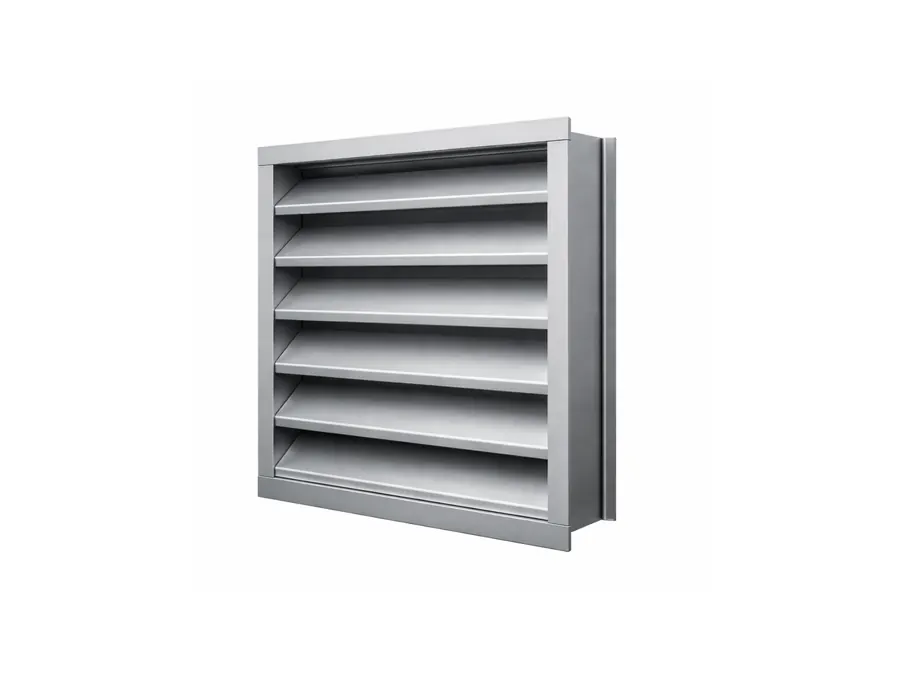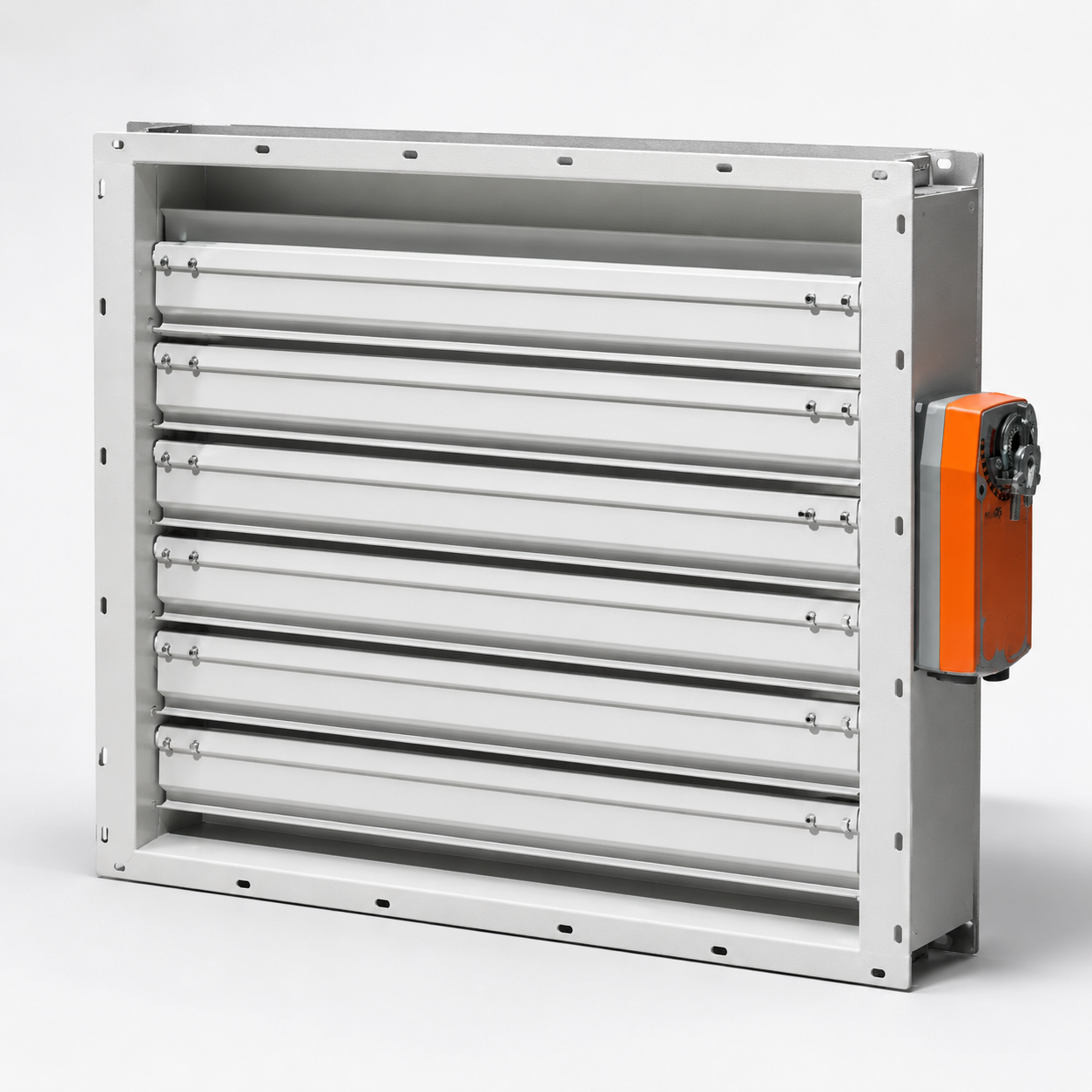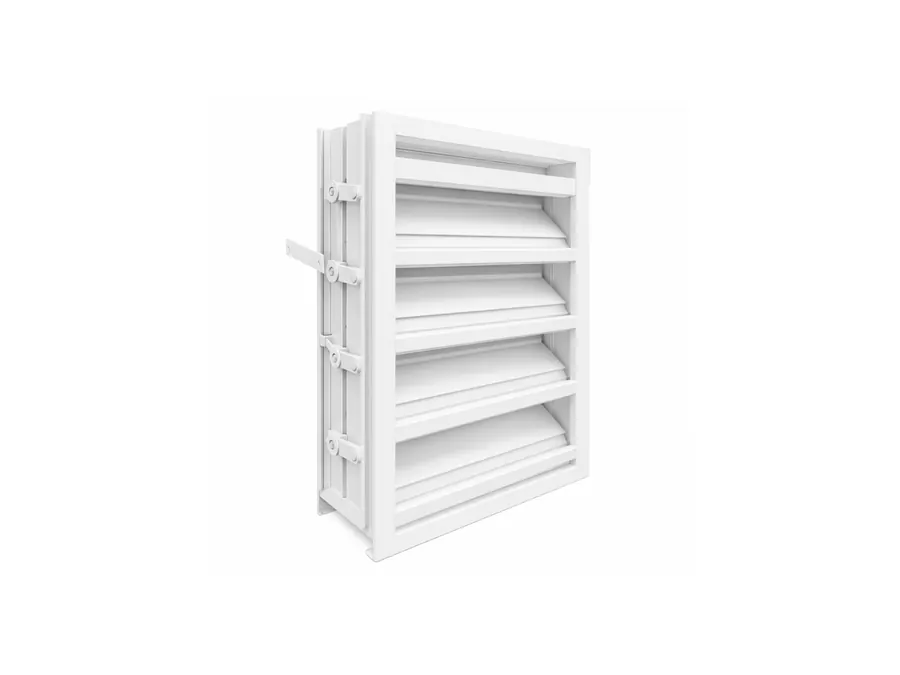
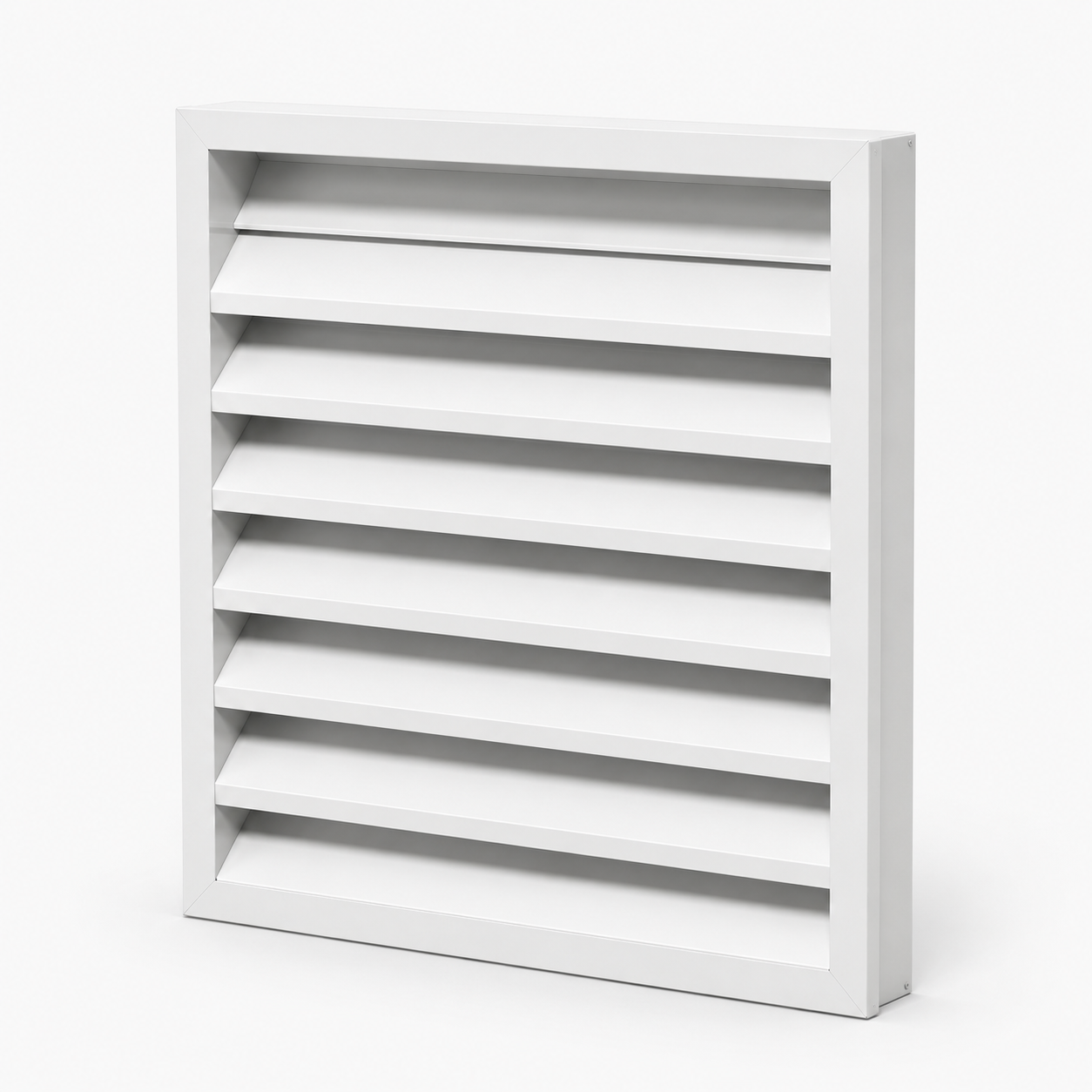
The five things a louver line must say
Most louver disputes — at tender, at approval, at inspection — trace back to a BOQ line that was technically silent on something important. A line that reads "Supply and fix aluminium weather louver, powder coated, 50% free area, Class A" looks specific and is in fact open to several honest readings that differ by a large margin in both performance and price.
A complete line controls five things:
- Size and quantity — opening size, panel module, and whether the rate includes mullions, flashings and sub-frames.
- Free area — the minimum percentage and whether it is measured before or after bird mesh and structural mullions.
- Water penetration — the class and the face velocity at which it must be achieved.
- Test basis and evidence — the standard, the laboratory accreditation, and whether certification is required.
- Material and finish — alloy, section type, coating system and film thickness.
Each of the next three sections takes the ones that cause the most trouble.
Where Louver Tenders Diverge
- ANSI/AMCA 500-L sets out the laboratory methods for air performance, water penetration, air leakage and free-area measurement — the 2023 edition added a dedicated free-area measurement section.
- A BS EN 13030 water-penetration class is tied to the face velocity it was measured at, so the class alone does not describe performance.
- AMCA 511 is the Certified Ratings Programme — the mechanism by which rated data is third-party verified rather than self-declared.
Free area: where the airflow quietly goes wrong
Free area is the percentage of the opening that air can actually pass through. It drives the fan calculation, and it is the single most commonly misstated figure in a louver BOQ.
The problem is that a louver has several defensible "free areas":
- Blade free area — the gaps between blades alone, the most flattering figure.
- Panel free area — after the panel frame, lower.
- Installed free area — after structural mullions across the opening, lower again.
- Effective free area — after bird or insect mesh, lowest, and the only one the fan experiences.
A fine bird mesh can take a significant share of the open area. So a tenderer quoting blade free area and one quoting effective free area can both write "50%" against the same line and be offering products whose real airflow differs substantially. The cheaper reading tends to win, and the shortfall surfaces at commissioning when the opening is already built.
The fix is one sentence in the BOQ: free area to be stated as the effective free area after bird mesh and structural mullions, measured in accordance with ANSI/AMCA 500-L. The 2023 edition of 500-L added a specific section on free-area measurement, which is exactly the ambiguity this clause closes. Our guide to louver construction and materials covers how mullions and mesh affect the build.
Free area is not a property of the blade. It is a property of the installed assembly, including the mesh nobody mentioned.
Rain class, and the velocity it was measured at
"Class A" is the most quoted and least qualified phrase in louver procurement. Under BS EN 13030, a louver is classified for water penetration by how much water passes at a defined airflow and simulated rainfall. The class and the velocity are a pair. Separate them and the class stops carrying information.
This matters because rain rejection degrades as face velocity rises. A louver that achieves Class A at a low test velocity may perform several classes worse at the velocity a continuously running plant intake imposes. Writing "Class A" with no velocity therefore permits a tenderer to offer a product tested in its most favourable condition and still comply.
What a BOQ should say instead:
| Weak clause | Why it fails | Better clause |
|---|---|---|
| "50% free area" | Four defensible readings | "Effective free area ≥50% after bird mesh and mullions, per AMCA 500-L" |
| "Class A rain defence" | No velocity, so not comparable | "Class A to BS EN 13030 at the scheduled design face velocity" |
| "AMCA compliant" | Undefined — compliant with what? | "Rated per AMCA 500-L; CRP certified per AMCA 511 where scheduled" |
| "Powder coated" | No system or thickness | "Polyester powder, stated minimum film thickness, to the project finish spec" |
| "Aluminium louver" | Extruded or folded sheet? | "Extruded aluminium to IS 1285, alloy and temper stated" |
The pattern is the same in every row: name the property, the standard, and the condition it must hold at. We go deeper on the velocity relationship in performance louver selection and on the classes themselves in EN 13030 Class A weather louvers.
Evidence, finish and the clauses that cause rejection
The last part of a louver line is the part that decides whether what arrives on site can be accepted. Three practical points.
Ask for evidence that matches the product. A test report is specific to a product and a size range. A report for a different model, or for a size well outside what is being supplied, is not evidence for the item on the schedule. Where third-party verification is wanted rather than self-declared data, the mechanism is the AMCA Certified Ratings Programme under AMCA 511 — we unpack the difference in AMCA 500-L versus AMCA 511 and the tender wording in "AMCA certified or equivalent". In India, NABL-accredited reports are commonly specified, and that accreditation is worth naming explicitly.
Specify the finish as a system. "Powder coated" is a process, not a specification. State the coating type, the minimum film thickness and the pre-treatment, and match it to the exposure — coastal and high-level elevations push towards anodising or PVDF, as set out in our powder coating versus anodising comparison. Performance-based finish references such as AAMA 2605 are useful where a durability clause is wanted.
Say what happens at inspection. Most rejections are avoidable and come from a small set of causes:
- Free area below the scheduled figure once mesh is fitted.
- Test evidence for a different model or size range than supplied.
- Folded-sheet construction supplied against an extruded specification.
- Film thickness below the stated minimum, or pre-treatment not evidenced.
- Mullions sized for a lower wind pressure than the location requires under IS 875 (Part 3).
KBG Group manufactures extruded aluminium performance, weather, acoustic, non-vision and sand-trap louvers with test data against AMCA 500-L methods, and our engineers will review a louver BOQ against the airflow and weather duty before you price it — including flagging the clauses that will be read two ways. Send us the schedule and we will mark up where the ambiguity is.
Frequently Asked Questions
What should a louver BOQ line item state as a minimum?
Five things: the opening or panel size and quantity; the minimum free area and whether that figure is before or after screening and mullions; the water-penetration class with the face velocity it applies at; the test standard and the evidence required; and the material, alloy and finish specification. A line missing any of these is open to two legitimate but different interpretations.
Why does it matter whether free area is quoted before or after mesh?
Because the fan sees only the effective open area. Bird or insect mesh can remove a substantial fraction of the geometric free area, so a louver quoted at 50% free area before mesh and one quoted at 50% after mesh are materially different products at materially different prices. If the basis is not stated, the cheaper interpretation usually wins the tender and the airflow shortfall appears at commissioning.
Is a Class A rain rating enough on its own?
No. A water-penetration class under BS EN 13030 is measured at a stated face velocity, so the class is only meaningful alongside that velocity. A Class A result obtained at a low test velocity says little about performance at the higher velocity a plant intake actually runs at. The BOQ should state the class and the velocity it must be achieved at.
What test evidence should be asked for in a tender?
Test reports against the methods in ANSI/AMCA 500-L for air performance, water penetration, air leakage and free area, from an accredited laboratory, for the product and size range being offered. Where third-party certification is wanted, the AMCA Certified Ratings Programme under AMCA 511 is the mechanism; in India, NABL-accredited test reports are commonly required. Asking for data on a product the supplier does not actually make is the usual way an untested louver enters a project.
Want a second pair of eyes on a louver BOQ before you price it?
Our engineers review specifications and share test data at no cost. Typical response within one business day.