A control damper is not a life-safety damper
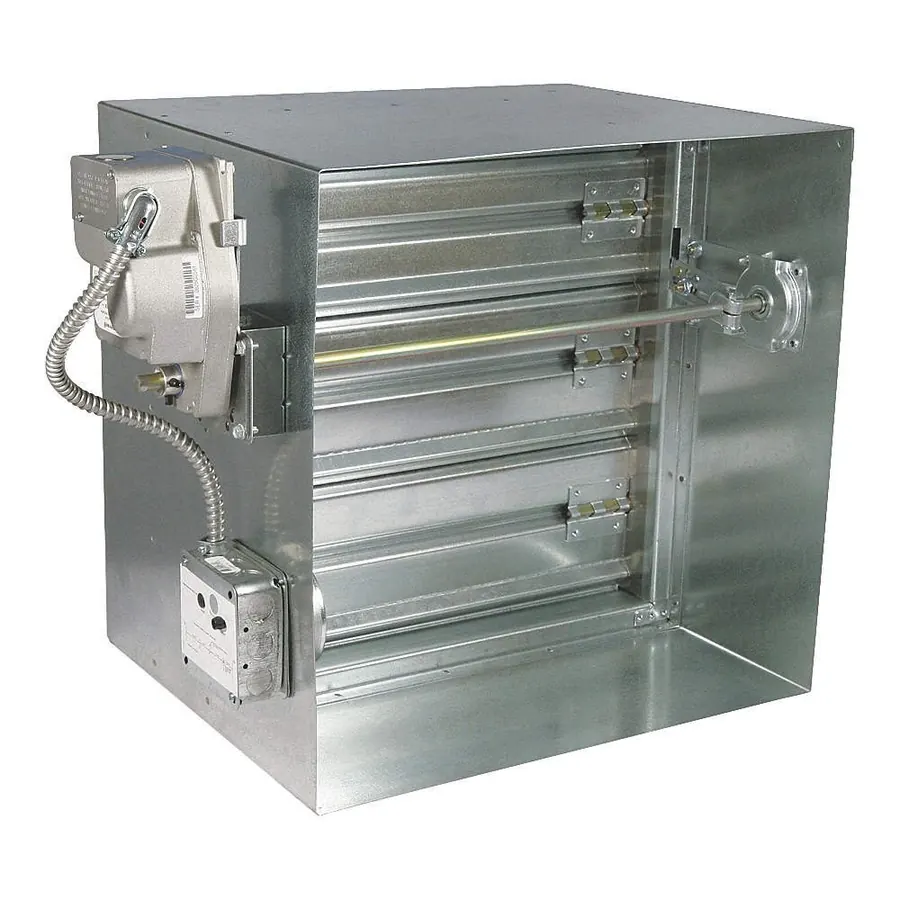
The word "damper" covers two jobs that must never be confused on a specification. A volume control damper (VCD) sets and holds airflow so each branch and terminal gets its design volume — a balancing and control device. A fire or smoke damper is a life-safety device that closes on command to stop fire or smoke spreading through the duct system; it is rated and tested to a different family of standards entirely. This article is about the first: the control damper that keeps a system in balance day to day. For the life-safety side, see the separate guide to fire & smoke damper specification.
Control dampers do quiet but essential work. Without them, air takes the path of least resistance — near branches over-flow, far branches starve, and no amount of fan capacity fixes it. The VCD is what lets a commissioning engineer set each branch to its design figure and lock it there.
- Balancing dampers — set once during commissioning and locked, to distribute design airflow.
- Modulating control dampers — driven by an actuator to vary flow (e.g. VAV, mixing, outside-air control).
- Backdraft / non-return dampers — open with forward flow and close against reverse flow, gravity- or spring-operated.
- Isolation dampers — low-leakage units for tight shut-off of a duct section.
Balance, Leakage & Energy
- Space conditioning and ventilation are among the largest energy end-uses in buildings worldwide (International Energy Agency), so leakage and balance carry a direct energy cost.
- An unbalanced system wastes fan energy pushing air where it is not needed while under-serving the spaces that are — a comfort and an efficiency failure at once.
- Damper aerodynamic performance and leakage are measured by recognised methods such as AMCA Standard 500-D, so published pressure-drop and leakage data can be compared like-for-like.
Blade type, blade profile and leakage class
Three construction choices decide how a control damper behaves: how the blades are linked, the blade profile, and how tightly it shuts. Each maps to a duty.
| Choice | Options | When to use which |
|---|---|---|
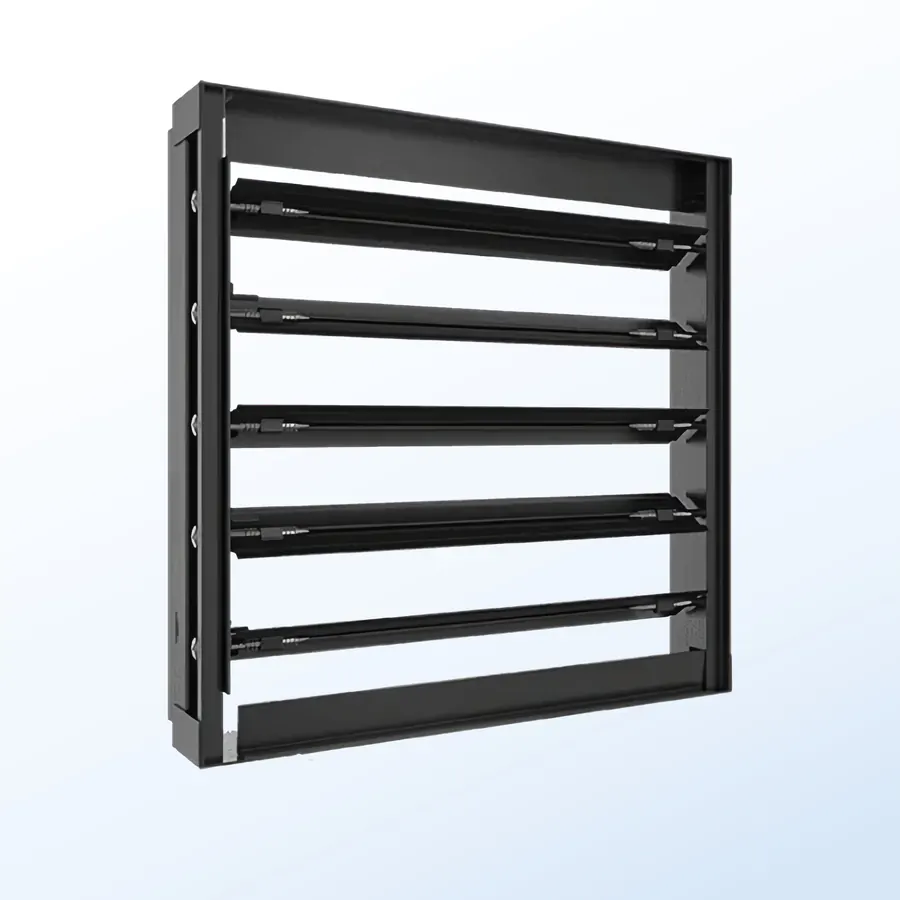
| Blade linkage | Opposed vs parallel blade | Opposed for throttling/balancing (more linear); parallel for on/off or intentional deflection/mixing |
| Blade profile | Flat vs aerofoil | Aerofoil for low pressure drop and lower noise at higher velocity; flat for general, lower-cost duty |
| Shut-off | Standard vs low-leakage | Low-leakage (with blade/jamb seals) for isolation and outside-air; standard for in-line balancing |
| Actuation | Manual quadrant vs motorised | Locking quadrant for set-and-forget balancing; actuator for modulating control |
Opposed blades throttle; parallel blades deflect. Fit a parallel-blade damper where you needed to modulate flow and the system fights you all the way to nearly-shut.
Leakage class is the figure people forget until it costs them. It describes how much air still passes when the damper is fully closed, measured to a method such as AMCA 500-D. For a balancing damper buried in a branch, modest leakage is harmless. For an isolation or outside-air damper — where a "closed" damper that leaks wastes energy or defeats a control sequence — a low-leakage unit with edge and jamb seals is worth specifying explicitly, by class, not by adjective.
Authority, placement and balancing
A control damper only controls if it has authority — a meaningful share of the branch's pressure drop. Under-size the pressure drop across the damper and it does almost nothing until it is nearly shut, then slams the flow closed over the last few degrees of travel: coarse, noisy, uncontrollable. Give it adequate authority and it modulates flow smoothly across its whole range. That is why a control damper is sized for its control duty, not simply cut to the duct size.
Placement matters just as much. A damper throttling hard generates noise, so it belongs away from terminals and sensitive spaces, with enough straight duct around it for predictable flow. And every balancing damper has to be accessible — a locked quadrant you cannot reach is a damper that never gets re-balanced. Final flows are set during testing, adjusting and balancing (TAB), when each damper is trimmed to its design figure and locked.
| Specification item | What to confirm |
|---|---|
| Damper type | Opposed/parallel blade, aerofoil/flat, standard/low-leakage — matched to the duty. |
| Leakage class | Stated by class (e.g. to AMCA 500-D) where tight shut-off matters. |
| Authority & sizing | Adequate pressure-drop share for smooth modulation, not just duct-fit sizing. |
| Actuation | Locking quadrant for balancing, or actuator for modulating control. |
| Access & placement | Reachable for setting; located away from terminals to limit noise. |
| Material & test data | Galvanised steel/aluminium, with published pressure-drop and leakage data. |
KBG Group manufactures volume control and balancing dampers — opposed- and parallel-blade, aerofoil low-loss, backdraft/non-return and low-leakage isolation types, with manual or motorised actuation — alongside fire and smoke dampers, so the balancing and life-safety hardware for a duct system come from one source. They pair directly with our air distribution products; the companion guide to air distribution device selection covers the terminal side of the same system.
Frequently Asked Questions
What is the difference between opposed-blade and parallel-blade dampers?
In an opposed-blade damper, adjacent blades rotate in opposite directions, giving more even, more linear flow control — the usual choice for throttling and balancing. In a parallel-blade damper all blades rotate the same way, deflecting the airstream to one side; useful for two-position duty or intentional mixing, but less precise for flow modulation.
What is a volume control damper used for?
A volume control damper (VCD) sets and holds the airflow in a duct branch or at a terminal so each space gets its design flow. It is a balancing and control device, distinct from a fire or smoke damper, which is a life-safety device that closes to stop fire or smoke spread.
What is damper authority?
Damper authority is how much of the branch's pressure drop the damper controls relative to the rest of the circuit. Too little authority and the damper barely changes flow until nearly shut, giving poor, non-linear control; adequate authority lets it modulate smoothly across its travel — a key reason a control damper is sized for its duty, not just to fit the duct.
What does damper leakage class mean?
Leakage class describes how much air passes through a damper when fully closed, measured by a method such as AMCA Standard 500-D. Low-leakage dampers are specified where tight shut-off matters — energy control, isolation, outside-air sections — while general balancing dampers can accept higher leakage. The published class lets specifiers compare dampers on the same basis.
Specifying control and balancing dampers for a project?
Our engineers review layouts and share pressure-drop and leakage data at no cost. Typical response within one business day.