The noise an airport actually makes
Designing for "aircraft noise" as a single number is the first mistake. An airport produces several distinct noise problems, and they call for different responses:
- Overflight and departure noise — high level, intermittent, and broadband with substantial low-frequency content.
- Ground running and taxiing — longer duration, lower level, and the dominant concern for buildings near aprons and engine-run areas.
- Auxiliary power units and ground support equipment — continuous, close to buildings, and often the real driver of a boundary complaint.
- The airport's own plant — chillers, AHUs, generators and cooling towers, which the airport is responsible for at its own boundary.
The distinction that matters for a louver is spectrum, not level. Low-frequency energy is hard to attenuate and needs depth; mid and high frequencies are comparatively easy. An acoustic louver chosen against an A-weighted average will underperform against a spectrum weighted to the low end, which is exactly what engine noise delivers. This is why the specification has to begin with octave-band data from the project acoustic assessment, and why our guide to noise studies for infrastructure projects treats the survey as the foundation rather than a formality.
On the compliance side, ambient limits in India come from the Noise Pollution (Regulation and Control) Rules, 2000, which set zone limits in dB(A) Leq — 75/70 for industrial, 65/55 for commercial, 55/45 for residential and 50/40 for silence zones, day and night respectively. Which of those applies to a given airport building is a zoning and consent question, settled in the project's acoustic report and the state board's conditions.
Why Octave Bands Decide the Design
- Attenuation through an absorptive louver is strongly frequency-dependent, so a single averaged insertion-loss figure cannot be checked against a spectrum.
- Low-frequency attenuation is bought with depth and absorptive path length, which is why acoustic louvers are far deeper than weather louvers.
- Ambient limits under the Noise Pollution Rules, 2000 are set as dB(A) Leq by zone and by day/night period, so compliance depends on zone, time and measurement position, not on the louver alone.
How an acoustic louver works
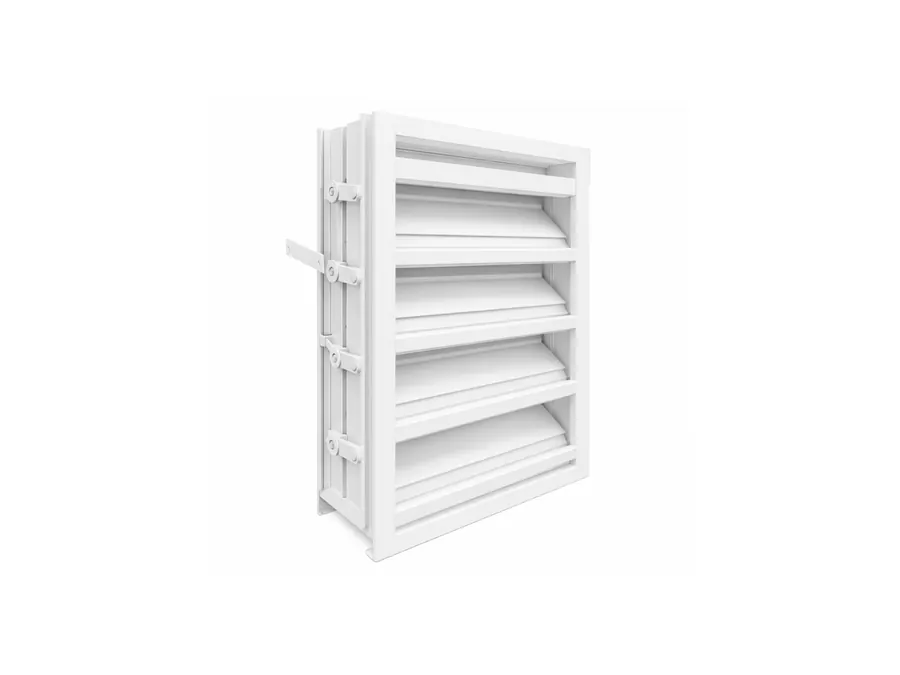
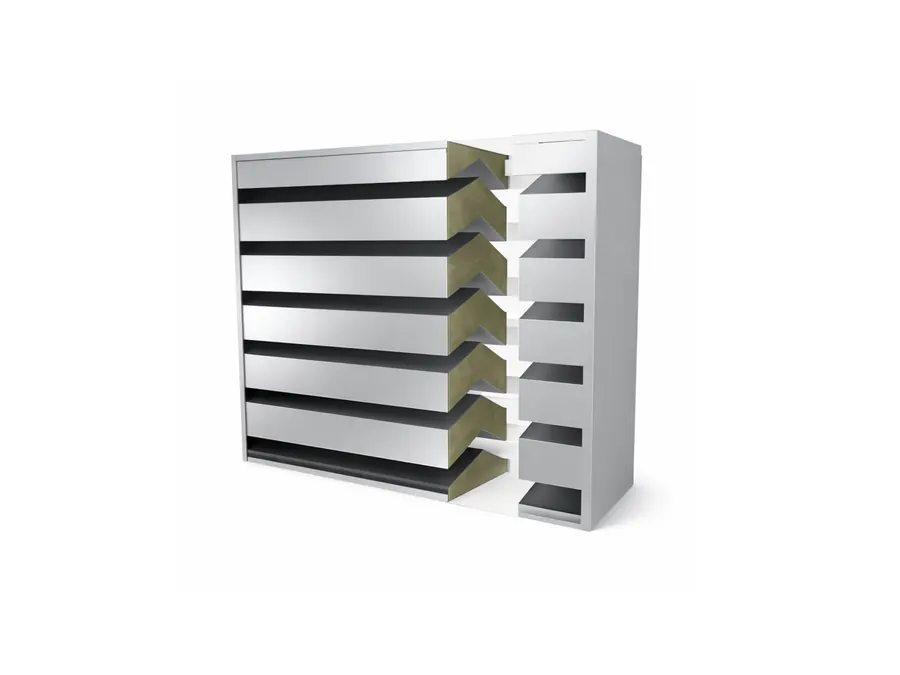
An acoustic louver is not a weather louver with insulation added. It is a short, aerodynamically shaped splitter attenuator dressed as a facade element. Each blade is a hollow aerofoil packed with sound-absorbing material behind a perforated facing. Air passes between the blades; sound entering the gaps is absorbed along the blade length as it reflects between facings.
Three design variables follow from that mechanism:
- Depth sets the absorptive path, and therefore the low-frequency performance. This is the main lever.
- Blade pitch sets the ratio of open gap to absorptive surface — tighter pitch gives more attenuation and less free area.
- Facing and infill set the absorption characteristic and have to survive the exposure, which outdoors means a facing that drains and an infill that does not slump or wick water.
Because the blades are deep and absorptive, an acoustic louver is also a weather element, but its rain performance should be verified rather than assumed: the geometry that is good for absorption is not automatically good for water rejection. Where both matter, the two requirements are stated separately — an insertion-loss schedule by octave band, and a water-penetration class per BS EN 13030 at the design face velocity, tested by the methods in ANSI/AMCA 500-L.
Insertion loss against pressure drop
This is the whole engineering problem in one sentence: everything that increases attenuation reduces airflow. Deeper blades, tighter pitch and more absorptive facing all buy decibels and spend free area.
The failure mode is familiar. An acoustic consultant sets an insertion-loss target; a louver is selected to meet it; the opening size is carried over from the earlier weather-louver design; and at commissioning the plant cannot pull its design airflow. The fix at that stage is expensive — a bigger opening in a built facade, or a bigger fan with its own noise problem.
The correct order of operations:
- Start with the octave-band target from the acoustic assessment, including the low bands.
- Select depth and pitch that meet the target with margin in the governing bands.
- Take the resulting free area and pressure drop at the design face velocity, measured per AMCA 500-L.
- Size the opening and the fan together, so the acoustic and airflow designs close on the same numbers.
| Requirement | Louver response | What it costs |
|---|---|---|
| Modest attenuation, mid/high frequency | Shallow acoustic blade | Small free-area penalty |
| Significant low-frequency attenuation | Deep blade, tighter pitch | Large free-area and pressure-drop penalty |
| Attenuation plus heavy rain exposure | Acoustic blade with verified water class | Depth plus drainage detailing |
| Attenuation beyond louver capability | Duct attenuator or acoustic plenum behind | Space inside the building |
An acoustic louver is a negotiation between decibels and cubic metres per second. Fix one in isolation and the other is decided for you — usually badly.
When a louver is the wrong tool
Acoustic louvers are the right answer for a ventilation opening in a facade facing a noise source. They are the wrong answer for several problems they get specified against:
- A noisy machine in a yard. Treat the source. An acoustic enclosure around the equipment is more effective and cheaper than treating every opening in the building behind it.
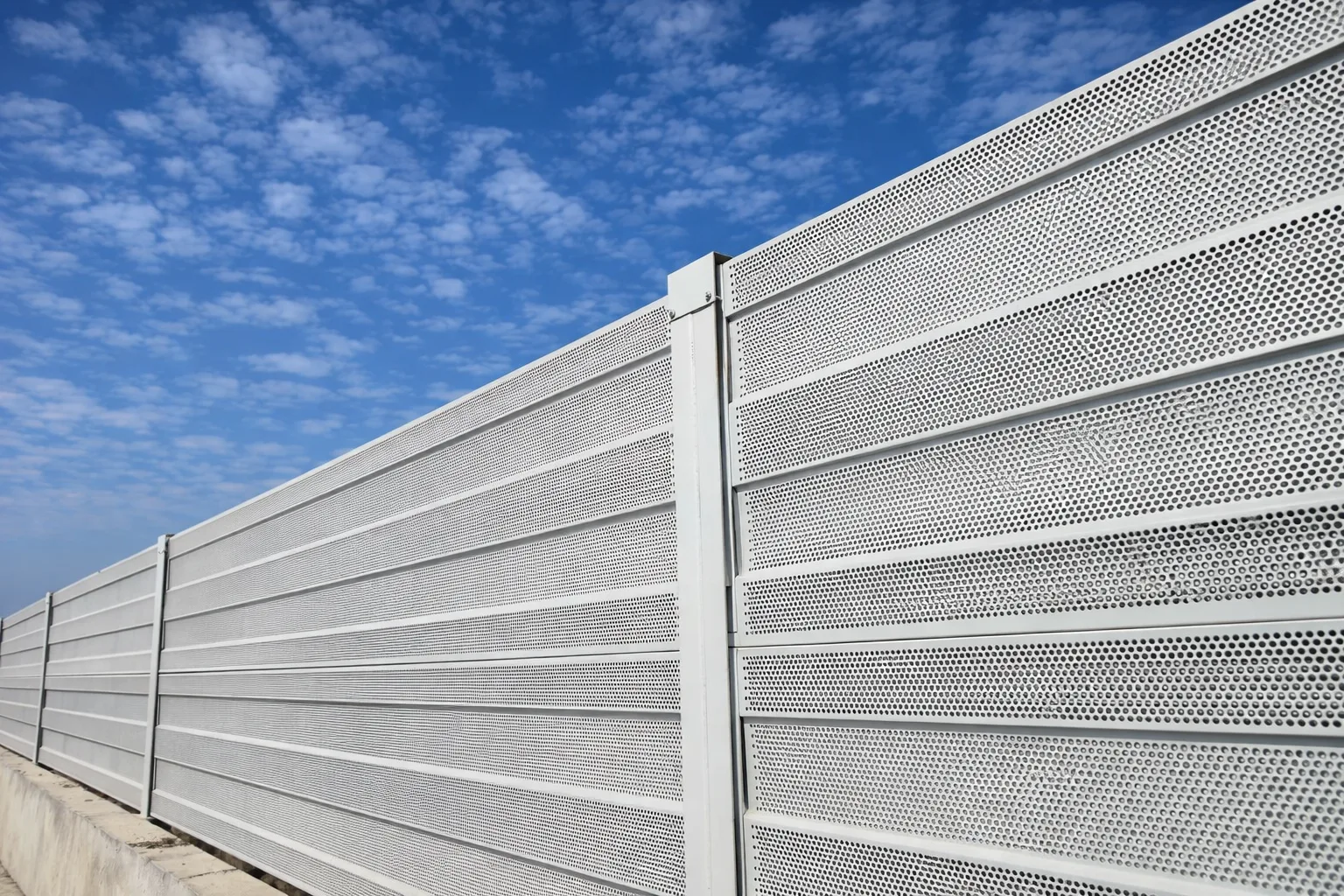
- A boundary-line problem. Where the issue is noise leaving a site towards a neighbour, a noise barrier on the line of sight does work a facade louver cannot.
- Very high attenuation targets. Beyond a point, depth stops being available in a facade and the attenuation has to move inboard into a duct attenuator or acoustic plenum.
- Rooftop plant on a mixed-use building. Screening the plant deck is usually the better intervention; we cover it in rooftop plant acoustic screening.
Our comparison of cladding, enclosures and barriers sets out where each belongs. KBG Group manufactures acoustic louvers, enclosures, barriers and cladding and will model insertion loss against your octave-band target alongside the free-area and pressure-drop consequence, so the acoustic and airflow cases are settled on one set of numbers before the opening is built.
Frequently Asked Questions
What is insertion loss on an acoustic louver?
Insertion loss is the reduction in sound transmitted through the opening, in decibels, created by fitting the louver. It is frequency-dependent and must be quoted per octave band, because a louver that performs well at 1 kHz may do very little at 125 Hz. A single average figure hides exactly the information a noise calculation needs.
Why does an acoustic louver need more depth than a weather louver?
Because attenuation comes from the length of absorptive path the sound has to travel. Acoustic louvers use deeper, sound-absorbing splitter blades, so a typical acoustic louver is several hundred millimetres deep against a weather louver's much shallower section. Depth is the resource that buys low-frequency performance, and it has to be allowed for in the facade build-up.
Does an acoustic louver reduce airflow?
Yes. Deeper absorptive blades mean lower free area and higher pressure drop than an equivalent weather louver, so the opening is larger or the fan works harder for the same airflow. The correct method is to design the two together: pick the insertion loss the noise target needs, then size the opening and the fan for the resulting pressure drop.
What noise limits apply around an airport in India?
Ambient limits come from the Noise Pollution (Regulation and Control) Rules, 2000, which set zone limits in dB(A) Leq for industrial, commercial, residential and silence zones by day and night. The limit that applies to a particular airport building depends on the zone it sits in and the state pollution control board's conditions, so the project acoustic report is the governing document rather than a generic figure.
Balancing airflow against a noise limit on an airport building?
Our engineers review specifications and share test data at no cost. Typical response within one business day.